

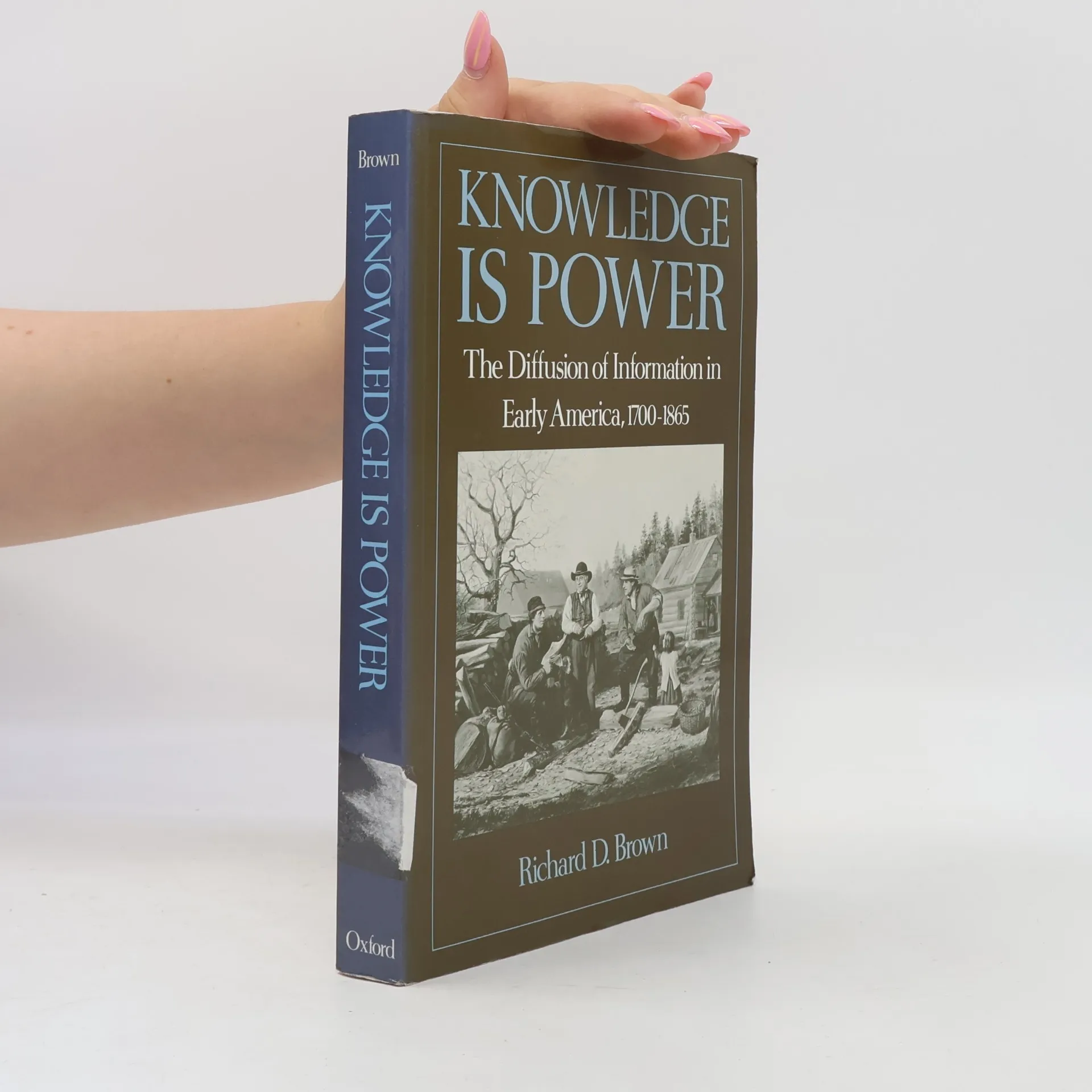



Knowledge Is Power
The Diffusion of Information in Early America, 1700-1865
Autoři
Více o knize
Brown here explores America's first communications revolution--the revolution that made printed goods and public oratory widely available and, by means of the steamboat, railroad and telegraph, sharply accelerated the pace at which information travelled. He describes the day-to-day experiences of dozens of men and women, and in the process illuminates the social dimensions of this profound, far-reaching transformation. Brown begins in Massachusetts and Virginia in the early 18th century, when public information was the precious possession of the wealthy, learned, and powerful, who used it to reinforce political order and cultural unity. Employing diaries and letters to trace how information moved through society during seven generations, he explains that by the Civil War era, cultural unity had become a thing of the past. Assisted by advanced technology and an expanding economy, Americans had created a pluralistic information marketplace in which all forms of public communication--print, oratory, and public meetings--were competing for the attention of free men and women. Knowledge is Power provides fresh insights into the foundations of American pluralism and deepens our perspective on the character of public communications in the United States.
Nákup knihy
Knowledge Is Power, Richard D Brown
- Jazyk

- Rok vydání
- 1989
- Vazba
- (měkká)
Doručení
Platební metody
Nikdo zatím neohodnotil.
- Titul
- Knowledge Is Power
- Podtitul
- The Diffusion of Information in Early America, 1700-1865
- Jazyk
- anglicky
- Autoři
- Richard D Brown
- Vydavatel
- Oxford University Press
- Rok vydání
- 1989
- Vazba
- měkká
- Počet stran
- 384
- ISBN10
- 0195072650
- ISBN13
- 9780195072655
- Série
- Kategorie
- Anotace
- Brown here explores America's first communications revolution--the revolution that made printed goods and public oratory widely available and, by means of the steamboat, railroad and telegraph, sharply accelerated the pace at which information travelled. He describes the day-to-day experiences of dozens of men and women, and in the process illuminates the social dimensions of this profound, far-reaching transformation. Brown begins in Massachusetts and Virginia in the early 18th century, when public information was the precious possession of the wealthy, learned, and powerful, who used it to reinforce political order and cultural unity. Employing diaries and letters to trace how information moved through society during seven generations, he explains that by the Civil War era, cultural unity had become a thing of the past. Assisted by advanced technology and an expanding economy, Americans had created a pluralistic information marketplace in which all forms of public communication--print, oratory, and public meetings--were competing for the attention of free men and women. Knowledge is Power provides fresh insights into the foundations of American pluralism and deepens our perspective on the character of public communications in the United States.