

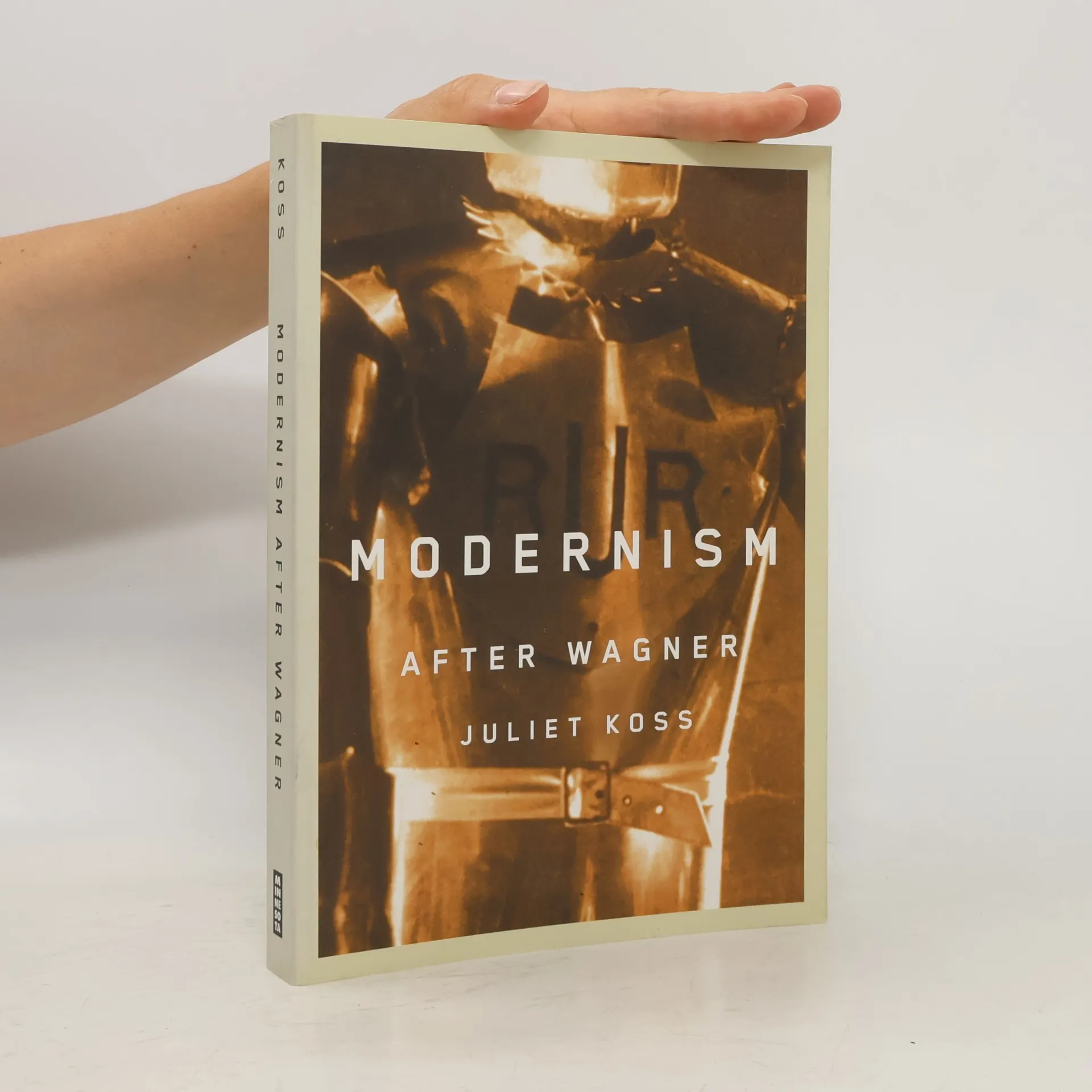
Modernism After Wagner
Autoři
Více o knize
References to the Gesamtkunstwerk, or "total work of art," frequently appear in discussions of modern art and culture, often highlighting a blend of various art forms that evoke strong emotions, hinder critical thought, and create a passive audience. Originating from Richard Wagner in 1849, this concept has been applied to diverse contexts, including 1920s Berlin cinema palaces and Andy Warhol's 1960s Factory. Juliet Koss examines the history and legacy of Wagner's idea, detailing its origins and the political, aesthetic, and cultural backdrop from which it arose, while tracing its evolution through the 1930s. Koss begins with Wagner's articulation of the Gesamtkunstwerk following the 1848-49 revolution, exploring key moments in German aesthetic theory and artistic practice. This includes Wagner's efforts to establish a theater for his music dramas, leading to the Bayreuth festival theater's construction in 1876; developments in visual arts, theater, film, and radio from the 1870s to the 1920s; the founding of the Darmstadt Artists' Colony in 1901 and the Munich Artists' Theater in 1908; and Bauhaus performances in the 1920s and 1930s. Koss also addresses the concept's appropriation by National Socialism, emphasizing its revolutionary roots and potential for emancipation. This rigorously researched work positions the Gesamtkunstwerk as central to modern art and culture.
Nákup knihy
Modernism After Wagner, Juliet Koss
- Jazyk

- Rok vydání
- 2010
- Vazba
- (měkká)
Doručení
Platební metody
Nikdo zatím neohodnotil.
- Titul
- Modernism After Wagner
- Jazyk
- anglicky
- Autoři
- Juliet Koss
- Vydavatel
- University of Minnesota Press
- Rok vydání
- 2010
- Vazba
- měkká
- Počet stran
- 392
- ISBN10
- 0816651590
- ISBN13
- 9780816651597
- Série
- Štítky
- Historické téma, Umění, Hudební tématika, USA, Německo, 20. století, 19. století, Historie umění, Kulturní historie, Vědecké teorie, Západní Evropa, Modernismus, Hudební věda, muzikologie
- Anotace
- References to the Gesamtkunstwerk, or "total work of art," frequently appear in discussions of modern art and culture, often highlighting a blend of various art forms that evoke strong emotions, hinder critical thought, and create a passive audience. Originating from Richard Wagner in 1849, this concept has been applied to diverse contexts, including 1920s Berlin cinema palaces and Andy Warhol's 1960s Factory. Juliet Koss examines the history and legacy of Wagner's idea, detailing its origins and the political, aesthetic, and cultural backdrop from which it arose, while tracing its evolution through the 1930s. Koss begins with Wagner's articulation of the Gesamtkunstwerk following the 1848-49 revolution, exploring key moments in German aesthetic theory and artistic practice. This includes Wagner's efforts to establish a theater for his music dramas, leading to the Bayreuth festival theater's construction in 1876; developments in visual arts, theater, film, and radio from the 1870s to the 1920s; the founding of the Darmstadt Artists' Colony in 1901 and the Munich Artists' Theater in 1908; and Bauhaus performances in the 1920s and 1930s. Koss also addresses the concept's appropriation by National Socialism, emphasizing its revolutionary roots and potential for emancipation. This rigorously researched work positions the Gesamtkunstwerk as central to modern art and culture.