

Více o knize
After the book "Basic Operator Theory" by Gohberg-Goldberg was pub lished, we, that is the present authors, intended to continue with another book which would show the readers the large variety of classes of operators and the important role they play in applications. The book was planned to be of modest size, but due to the profusion of results in this area of analysis, the number of topics grew larger than ex pected. Consequently, we decided to divide the material into two volumes - the first volume being presented now. During the past years, courses and seminars were given at our respective in stitutions based on parts of the texts. These were well received by the audience and enabled us to make appropriate choices for the topics and presentation for the two vol umes. We would like to thank G.J. Groenewald, A.B. Kuijper and A.C.M. Ran of the Vrije Universiteit at Amsterdam, who provided us with lists of remarks and corrections. We are now aware that the Basic Operator Theory book should be revised so that it may suitably fit in with our present volumes. This revision is planned to be the last step of an induction and not the first."
Nákup knihy
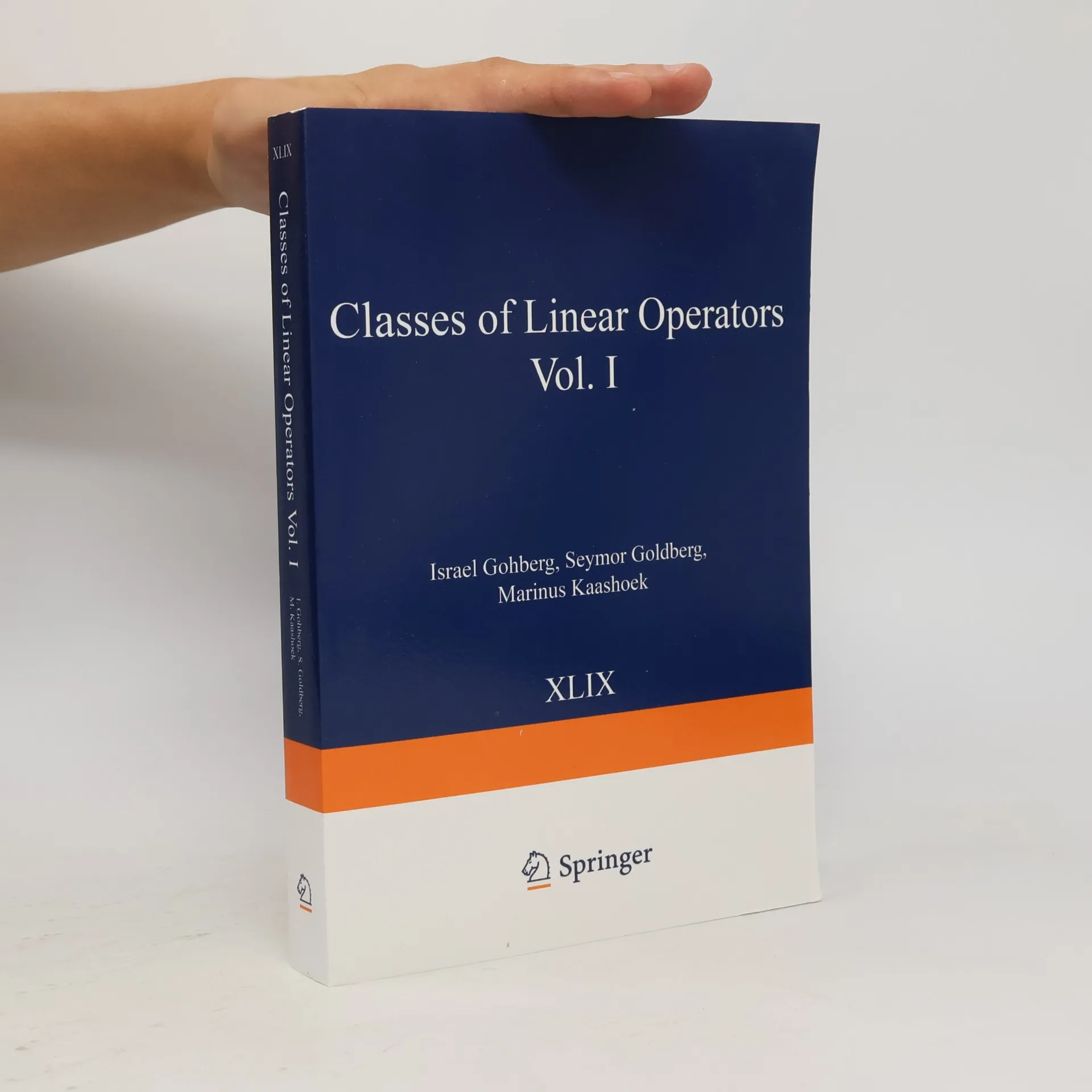
Operator Theory: Advances and Applications - 49: Classes of Linear Operators Vol. I, Israel Gohberg, Seymor Goldberg, Marinus Kaashoek
- Jazyk

- Rok vydání
- 2013
- Vazba
- (měkká),
- Stav knihy
- Dobrá
- Cena
- 1 199 Kč
Nikdo zatím neohodnotil.
- Titul
- Operator Theory: Advances and Applications - 49: Classes of Linear Operators Vol. I
- Jazyk
- anglicky
- Vydavatel
- Birkh h user
- Rok vydání
- 2013
- Vazba
- měkká
- Počet stran
- 481
- ISBN10
- 3034875118
- ISBN13
- 9783034875110
- Série
- Anotace
- After the book "Basic Operator Theory" by Gohberg-Goldberg was pub lished, we, that is the present authors, intended to continue with another book which would show the readers the large variety of classes of operators and the important role they play in applications. The book was planned to be of modest size, but due to the profusion of results in this area of analysis, the number of topics grew larger than ex pected. Consequently, we decided to divide the material into two volumes - the first volume being presented now. During the past years, courses and seminars were given at our respective in stitutions based on parts of the texts. These were well received by the audience and enabled us to make appropriate choices for the topics and presentation for the two vol umes. We would like to thank G.J. Groenewald, A.B. Kuijper and A.C.M. Ran of the Vrije Universiteit at Amsterdam, who provided us with lists of remarks and corrections. We are now aware that the Basic Operator Theory book should be revised so that it may suitably fit in with our present volumes. This revision is planned to be the last step of an induction and not the first."