


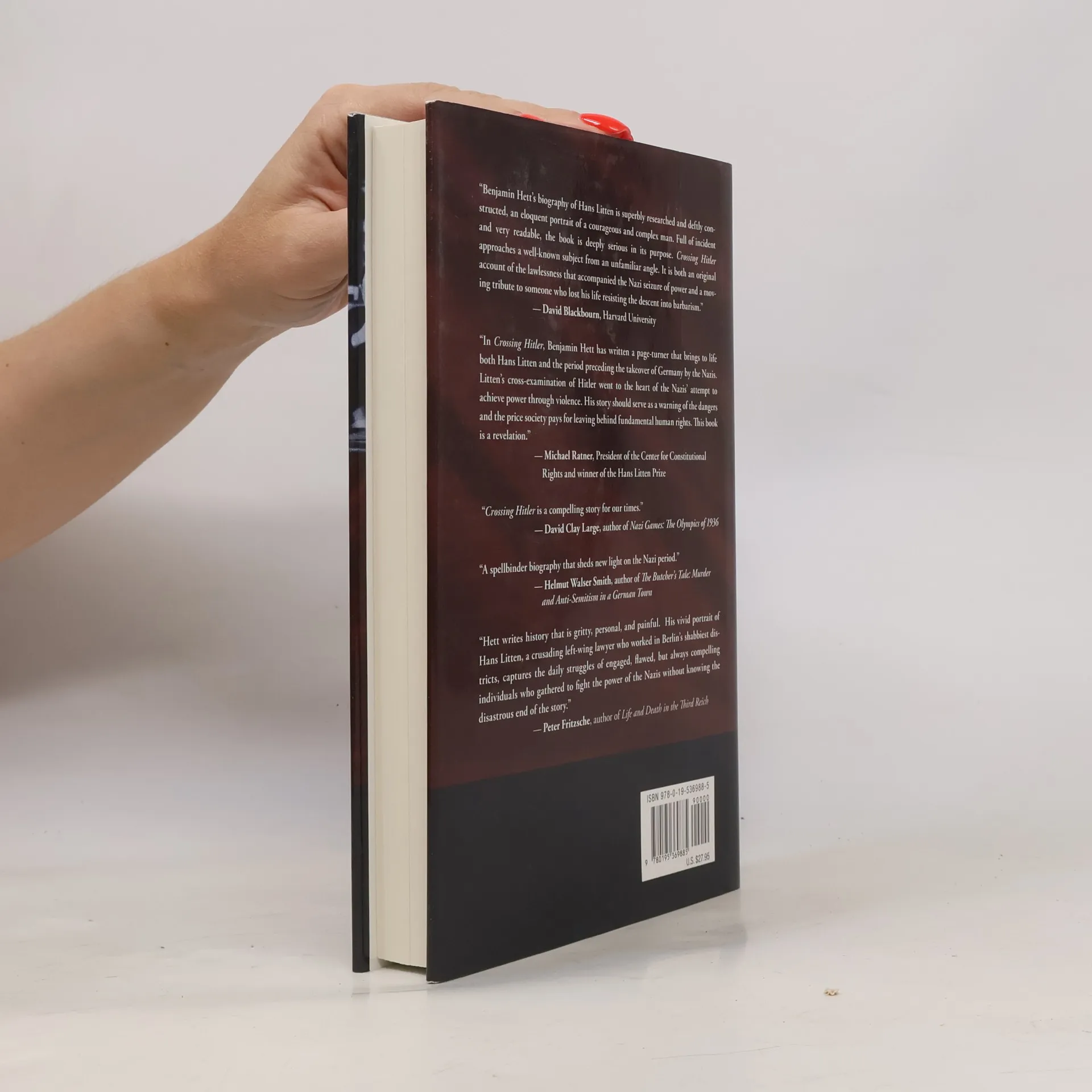

Crossing Hitler
The Man Who Put the Nazis on the Witness Stand
Autoři
Parametry
- 349 stránek
- 13 hodin čtení
Více o knize
During the 1931 Eden Dance Palace trial, Hans Litten conducted a remarkable three-hour cross-examination of Hitler, exposing contradictions and reducing him to a state of rage. At that time, Hitler sought to portray himself as a legitimate political figure, distancing himself from his stormtroopers. Litten's courageous questioning posed a significant threat to Nazi ambitions. After the Nazis rose to power two years later, Litten's friends and family urged him to flee, but he chose to stay and was subsequently imprisoned in concentration camps. There, he translated medieval German poetry, shared resources with fellow inmates, and educated working-class prisoners about art and literature. Litten provided solace to Jewish inmates at Dachau by reciting literary works from memory during their confinement. After enduring five years of brutal treatment and a failed escape attempt, he lost hope for survival. His story, while tragic, is also one of redemption, illustrating human nobility in the face of barbarism. This biography delves into Litten's life and the tumultuous era of the Weimar Republic, as well as the terror that followed under Nazi rule. It won the 2007 Fraenkel Prize for contemporary history and is set for global publication.
Nákup knihy
Crossing Hitler, Benjamin Carter Hett
- Jazyk

- Rok vydání
- 2008
- Vazba
- (pevná),
- Stav knihy
- Velmi dobrá
- Cena
- 329 Kč
Doručení
Platební metody
- Titul
- Crossing Hitler
- Podtitul
- The Man Who Put the Nazis on the Witness Stand
- Jazyk
- anglicky
- Autoři
- Benjamin Carter Hett
- Vydavatel
- Oxford Univ. Press
- Rok vydání
- 2008
- Vazba
- pevná
- Počet stran
- 349
- ISBN10
- 0195369882
- ISBN13
- 9780195369885
- Série
- Kategorie
- Štítky
- Historické téma, Právní tématika, USA, Německo, 20. století, Druhá světová válka, Vzpomínky, Politické teorie, Holokaust, Lidská práva, Právníci, Výmarská republika, Právní historie, Dachau (koncentrační tábor)
- Anotace
- During the 1931 Eden Dance Palace trial, Hans Litten conducted a remarkable three-hour cross-examination of Hitler, exposing contradictions and reducing him to a state of rage. At that time, Hitler sought to portray himself as a legitimate political figure, distancing himself from his stormtroopers. Litten's courageous questioning posed a significant threat to Nazi ambitions. After the Nazis rose to power two years later, Litten's friends and family urged him to flee, but he chose to stay and was subsequently imprisoned in concentration camps. There, he translated medieval German poetry, shared resources with fellow inmates, and educated working-class prisoners about art and literature. Litten provided solace to Jewish inmates at Dachau by reciting literary works from memory during their confinement. After enduring five years of brutal treatment and a failed escape attempt, he lost hope for survival. His story, while tragic, is also one of redemption, illustrating human nobility in the face of barbarism. This biography delves into Litten's life and the tumultuous era of the Weimar Republic, as well as the terror that followed under Nazi rule. It won the 2007 Fraenkel Prize for contemporary history and is set for global publication.