

Knihobot

Ilka Ruby

    Harquitectes
    On Lacaton & Vassal
    MVRDV buildings
    The economy of sustainable construction
    The Materials Book
    Infrastructure space
    • Infrastructure space

      • 421 stránek
      • 15 hodin čtení
      5,0(1)Ohodnotit

      Is infrastructure merely the plumbing and wiring of our environment, or is it the lifeblood of our spaces? Infrastructural systems enable the flow of people, goods, resources, and information, shaping buildings, cities, and entire nations. Recognizing this critical role, the text advocates for redefining infrastructure not just as a technical concern but as a political, economic, social, and aesthetic issue that impacts everyone. It argues for viewing infrastructure as essential for achieving resilient development and as a right to sustainable living. The work features twenty-five essays from architects, engineers, urban theorists, and policymakers, exploring infrastructure as a ‘thing,’ a ‘networked system,’ and an ‘agency’ across three chapters. These essays are complemented by a visual atlas that celebrates infrastructure's spatial qualities. Contributors include notable figures such as Marc Angélil, Tom Avermaete, Neil Brenner, Keller Easterling, and many others, along with a Visual Atlas of Infrastructure by Something Fantastic. This collection invites readers to reconsider the significance of infrastructure in shaping our world.

      Infrastructure space
    • To achieve truly climate-friendly architecture means not just switching to sources of renewable power, but building with materials that produce zero carbon emissions, use no fossil fuels, and create no waste. This publication contains essays, case studies, and a catalogue of building materials compiled by more than 60 architects, engineers, and scientists from around the world that deal with the environmentally mindful and socially responsible use of materials and resources. Ideas range from centuries-old traditions to newly developed biomaterials, from low-tech, artisanal methods to advanced digital technologies, and from incremental shifts to massive, top-down changes.

      The Materials Book
    • The economy of sustainable construction

      • 414 stránek
      • 15 hodin čtení
      2,0(1)Ohodnotit

      Sustainability's primary challenge lies in financial perceptions. Investors and developers often cite the supposed higher costs and lower profits of sustainable construction as reasons for noncompliance with sustainability standards. However, with rapid urbanization, a sluggish economy, and an escalating climate crisis, the need for sustainable construction practices is more urgent than ever. This work aims to debunk the myth that sustainability is unprofitable, assess current architectural practices, and introduce innovative materials and methods to enhance the environmental, social, and economic performance of buildings. Through a collection of essays, reports, and case studies, it examines the interplay between commercial and sustainable values while exploring the future trajectory of construction in the twenty-first century. Contributions from a diverse group of experts—including architects, urban planners, and sustainability advocates—provide insights into how sustainable practices can be integrated into the built environment. This exploration not only highlights the potential for profitability in sustainable construction but also emphasizes the critical need for a paradigm shift in how we approach building design and construction in an increasingly challenged world.

      The economy of sustainable construction
    • MVRDV buildings

      • 400 stránek
      • 14 hodin čtení

      Since they amazed the world with their design of the Dutch pavilion at the 2000 World Expo, MVRDV has been regarded as one of the world's top architecture bureaus. This monograph gives details about its realized work, featuring user testimonies, journalistic articles, unpublished images and accessible drawings.

      MVRDV buildings
    • Dieses Buch versammelt erstmals alle Artikel, Essays und Interviews, die Ilka und Andreas Ruby über das Werk der Pritzker-Preisträger Lacaton & Vassal verfasst haben. Beginnend mit ihrem ersten Essay “Naïve Architecture” aus dem Jahr 2002 haben die Texte der Rubys entscheidend zur kritischen Auseinandersetzung mit dem Werk des französischen Architekten-Duos beigetragen. In den 1990er Jahren, als Lacaton & Vassal international bekannt wurden, wurde ihre Arbeit oft missverstanden und als Versuch interpretiert, möglichst „billig“ zu bauen. Die Autoren argumentieren jedoch, dass die Häuser von Lacaton & Vassal einen Luxus an Raum schaffen, den die Architekten durch den Einsatz preiswerter Materialien und Bauweisen ihren Bewohnern bieten. Damit üben Lacaton & Vassal eine radikale Kritik am modernistischen Existenzminimum aus, das die Größe einer Wohnung als rein ökonomische Funktion des Budgets betrachtet. Sie befreien den Diskurs des sozialen Wohnungsbaus von dieser reduktionistischen Sichtweise und zeigen, dass räumliche Großzügigkeit in der Architektur nicht nur vom Budget abhängt, sondern vom Respekt der Architekten vor dem Leben ihrer Nutzer. In der Anmutung einer literarischen Taschenausgabe ergänzt das Buch die Texte mit einer sorgfältig ausgewählten Abbildungsreihe und einem Verzeichnis der in den Texten erwähnten Projekte.

      On Lacaton & Vassal
    • Harquitectes

      • 160 stránek
      • 6 hodin čtení

      Harquitectes ist ein junges Architekturbüro, das 2000 in Sabadell, einer Stadt nordwestlich von Barcelona, gegründet wurde. Infolge des wirtschaftlichen Abschwungs Spaniens reagierte das Studio auf die neuen, durch die Wirtschaftskrise ausgelösten Unsicherheiten und weitete seine Arbeit auf jede Art von Aufträgen aus: von öffentlichen Gebäuden, wie Schulen und Universitätseinrichtungen, bis zu Einfamilienhäusern. Diese Publikation ist die erste umfassende Werkmonografie dazu.

      Harquitectes
    • The book presents Frédéric Druot’s and Lacaton & Vassal’s retrofit of Tour Bois le Prêtre ; a decaying residential tower on the outskirts of Paris that even though occupied was envisioned for demolition. The architects renovated the existing structure and apartments while the inhabitants continued to live in them. Although the living area of each apartment increased by about 40 percent ; the rents stayed the same. Nevertheless ; the entire project cost less than what the French government had originally planned to spend on demolition the existing building and erecting a new one. More than an architectural project ; the Tour Bois-le-Prêtre offers a model for architects ; planners ; conservationists ; developers ; and politicians to engage with one of the most important challenges in the coming decades: the physical and social rehabilitation of the mass-produced housing developments of the 1960s and 1970s across Europe.

      Druot, Lacaton & Vassal
    • Grüntuch Ernst

      • 289 stránek
      • 11 hodin čtení

      What is space? How can we experience it with the senses, how understand and rethink its urban and cultural dimensions? These questions stand at the beginning of the work of Grüntuch Ernst architects. They meet the complex requirements of building today by going back to traditional simplicity while producing innovative and ingenious technical solutions―and yet they return, time and again, to the central question of space. The new monograph offers a review of Grüntuch Ernst’s awardwinning projects from the past ten years as well as more recent works and successful competition entries such as the German School in Madrid and the conversion of the former Jewish Girls’ School in Berlin into a venue for art and culture. Instead of traditional project descriptions, the book contains personal conversations in which the two architects reflect on the motivations that drive their projects and trace their evolution. For instance the paintings of the Danish artist A smund HavsteenMikkelsen provide a unique view of the studio’s work; he has engaged Grüntuch Ernst’s architecture with the means of his own art in a series of pictures

      Grüntuch Ernst
    • Published in conjunction with a solo exhibition, this recent publication on the work of the renowned Austrian-German architecture practice Riegler Riewe offers an insightful exploration of their spatial imagination. It showcases 16 significant projects in two distinct yet visually harmonious formats. The first part features full-page illustrations that depict architectural space through a captivating visual estrangement—void spaces are left unprinted, while the architectural elements are rendered in a subtle shade of purple-beige, the book's sole color. The surrounding paper, printed in the same hue, creates an effect reminiscent of archaeological excavations, inviting readers to perceive Riegler Riewe's work in a novel way. This manipulation encourages imagination about the unknown, suggesting various potential functions for these ambiguous spaces. The second part of the book presents detailed documentation of the projects through customary line drawings, shown to scale and accompanied by precise captions outlining their spatial programs. A critical essay by Andreas Ruby bridges the two sections, introducing readers to the architectural implications of Riegler Riewe’s unique conceptual approach.

      Die Tiefe der Fläche
    • Urban transformation

      • 399 stránek
      • 14 hodin čtení

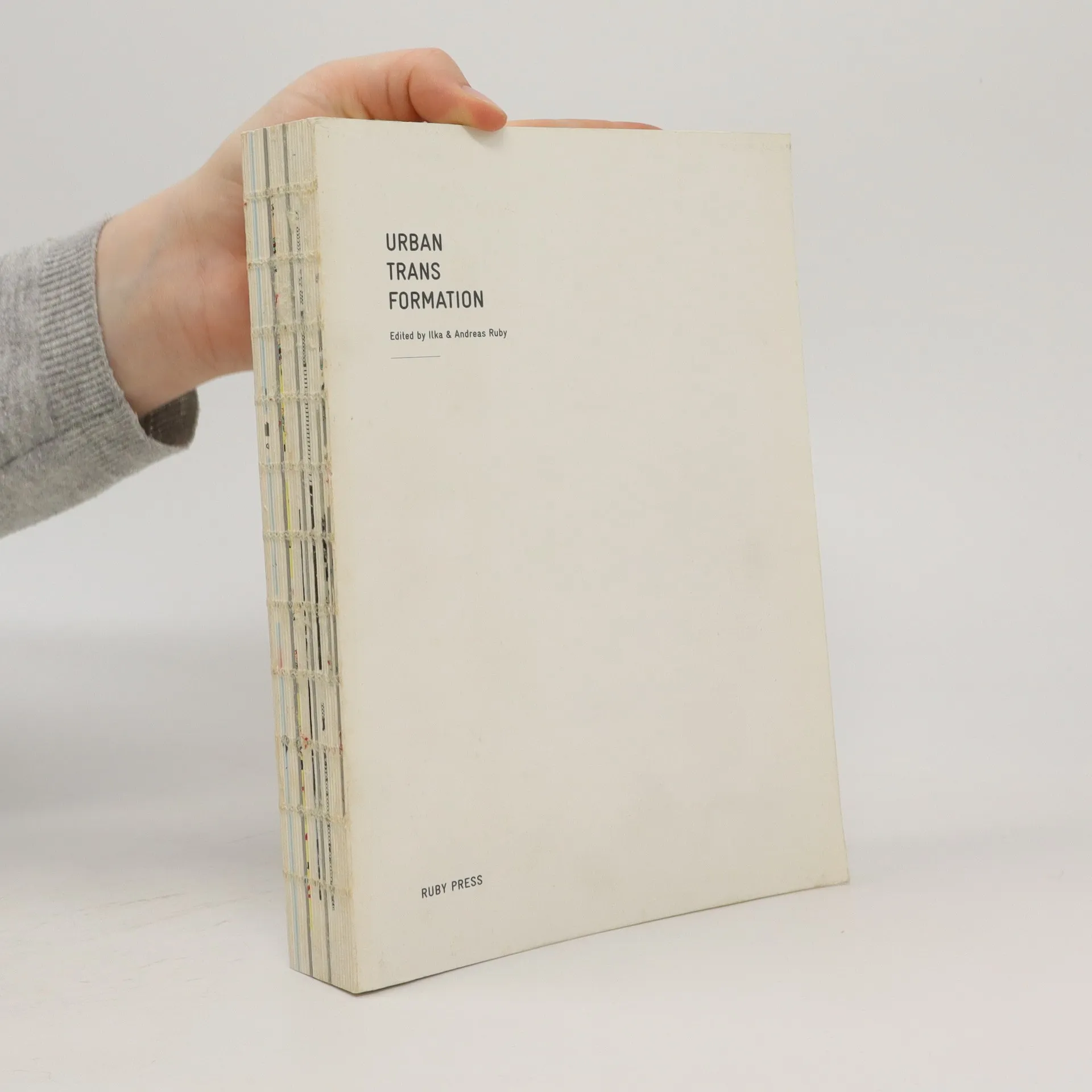
      Tell me what is urban for you and I tell you who you are. As opposed to the colonial era of the 19th century, the term “urban” today no longer indexes a normative cultural concept—such as expressed, for instance, in the “European City”—but represents a cosmos of extremely varied notions determined by geographical, cultural, and individual preferences. If we want to get a grip on what is “urban” today, we have to capture it in all its disguises, gradations, and transformations occurring simultaneously on a global scale. Urban Transformation takes us on a global dérive through a carefully selected series of emerging urban conditions in five continents, seen through the eyes of more than 50 international architects, urban planners, politicians, and artists including Saskia Sassen, Robert Somol, Jean-Philippe Vassal, Eyal Weizman, Teddy Cruz, Keller Easterling, Rahul Mehrotra, Enrique Peñalosa. The book makes a pledge for a differentiated understanding of urban culture at the beginning of the 21st century, embracing cultural idiosyncracy while adhering to a universal ambition: to cultivate the city as the prime arena of human existence, not only because it is the place where since recently the majority of the global population is living, but also because the city is the only type of spatial organization able to accommodate an ever-increasing amount of people on earth in a sustainable way.

      Urban transformation