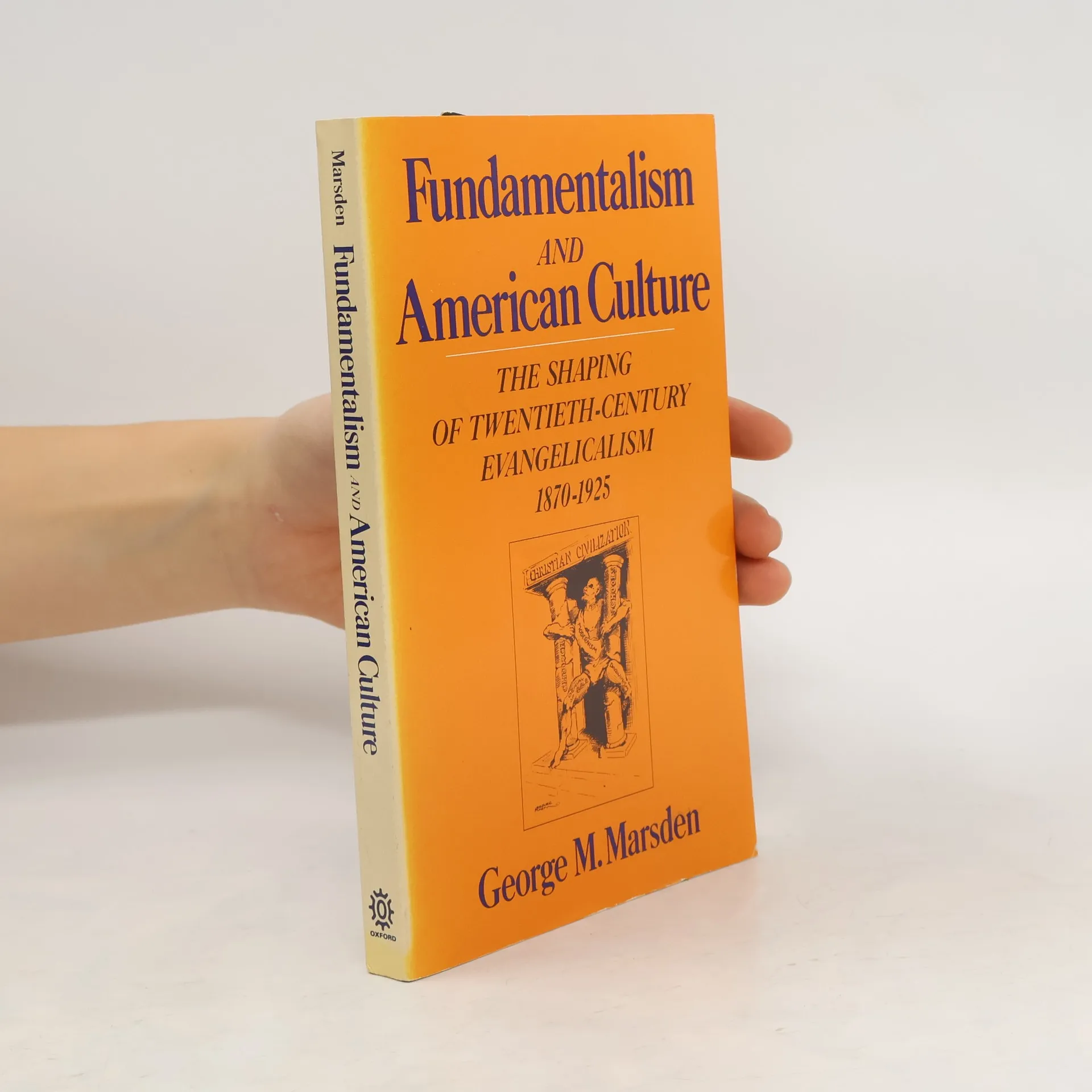
George M. Marsden se zabývá interakcí mezi křesťanstvím a americkou kulturou. Jeho rozsáhlé dílo analyzuje, jak náboženské přesvědčení formovalo americkou společnost. Prostřednictvím pečlivého historického bádání nabízí vhled do složitých vztahů mezi vírou a civilizací. Jeho práce jsou ceněny pro svou hloubku a erudici.
Jonathan Edwards (1703–1758) is a towering figure in American history. A controversial theologian and the author of the famous sermon Sinners in the Hands of an Angry God, he ignited the momentous Great Awakening of the eighteenth century.In this definitive and long-awaited biography, Jonathan Edwards emerges as both a great American and a brilliant Christian. George Marsden evokes the world of colonial New England in which Edwards was reared—a frontier civilization at the center of a conflict between Native Americans, French Catholics, and English Protestants. Drawing on newly available sources, Marsden demonstrates how these cultural and religious battles shaped Edwards’s life and thought. Marsden reveals Edwards as a complex thinker and human being who struggled to reconcile his Puritan heritage with the secular, modern world emerging out of the Enlightenment. In this, Edwards’s life anticipated the deep contradictions of our American culture.Meticulously researched and beautifully composed, this biography offers a compelling portrait of an eminent American.
A best-selling text thoroughly updated, including new chapters on the last 30 years "An excellent study that will help historians appreciate the importance of Christianity in the history of the United States and Canada." - The Journal of American History "Scholars and general readers alike will gain unique insights into the multifaceted character of Christianity in its New World environment. Nothing short of brilliant." - Harry S. Stout, Yale University "A new standard for textbooks on the history of North American Christianity." - James Turner, University of Notre Dame Mark Noll's A History of Christianity in the United States and Canada has been firmly established as the standard text on the Christian experience in North America. Now Noll has thoroughly revised, updated, and expanded his classic text to incorporate new materials and important themes, events, leaders, and changes of the last thirty years. Once again readers will benefit from his insights on the United States and Canada in this superb narrative survey of Christian churches, institutions, and cultural engagements from the colonial period through 2018.
An illuminating Look at who evangelicals are, how evangelicalism has changed over time, and How Evangelicalism Continues to Develop in surprising ways Book jacket.
Chronicles the history of the fundamentalist movement in the United States and discusses how the social, political, and intellectual aspects of Protestant fundamentalism affected the movement.
The first in a series of books presenting a connected history of evangelical
movements in the English-speaking world spread over nearly three centuries.
The life and times of C. S. Lewis's modern spiritual classic Mere Christianity, C. S. Lewis's eloquent defense of the Christian faith, originated as a series of BBC radio talks broadcast during the dark days of World War Two. Here is the story of the extraordinary life and afterlife of this influential and inspiring book. George Marsden describes how Lewis gradually went from being an atheist to a committed Anglican—famously converting to Christianity in 1931 after conversing into the night with his friends J. R. R. Tolkien and Hugh Dyson—and how his plainspoken case for Christianity went on to become one of the most beloved spiritual books of all time.
From Protestant Establishment to Established Nonbelief
480 stránek
17 hodin čtení
Only a century ago, almost all state universities held compulsory chapel services, and some required Sunday church attendance as well. In fact, state-sponsored chapel services were commonplace until the World War II era, and as late as the 1950s, it was not unusual for leading schools to refer to themselves as "Christian" institutions. Today, the once pervasive influence of religion in the intellectual and cultural life of America's preeminent colleges and universities has all but vanished. In <em>The Soul of the American University</em>, George Marsden explores how, and why, these dramatic changes occurred. Far from a lament for a lost golden age when mainline Protestants ruled American education, <em>The Soul of the American University</em> offers a penetrating critique of that era, surveying the role of Protestantism in higher education from the founding of Harvard in the 1630s through the collapse of the WASP establishment in the 1960s. Marsden tells the stories of many of our pace-setting universities at defining moments in their histories, including Harvard, Yale, Princeton, the University of Michigan, Johns Hopkins, the University of California at Berkeley, and the University of Chicago. He recreates the religious feuds that accompanied Yale's transition from a flagship evangelical college to a university, and the dramatic debate over the place of religion in higher education between Harvard's President Charles Eliot and Princeton's President James McCosh. Marsden's analysis ranges from debates over Darwinism and higher criticism of the Bible, to the roles of government and wealthy contributors, the impact of changing student mores, and even the religious functions of college football. He argues persuasively that the values of "liberalism" and "tolerance" that the establishment championed and used to marginalize Christian fundamentalism and Roman Catholicism eventually and perhaps inevitably led to its own disappearance from the educational milieu, as nonsectarian came to mean exclusively secular. While the largely voluntary disestablishment of religion may appear in many respects commendable, Marsden believes that it has nonetheless led to the infringement of the free exercise of religion in most of academic life. In effect, nonbelief has been established as the only valid academic perspective. In a provocative final chapter, Marsden spells out his own prescription for change, arguing that just as the academy has made room for feminist and multicultural perspectives, so should there be room once again for traditional religious viewpoints. A thoughtful blend of historical narrative and searching analysis, The Soul of the American University exemplifies what it advocates: that religious perspectives can provide a legitimate contribution to the highest level of scholarship.