

This text provides an introduction to the process of software engineering. The revision concentrates on updating the book to reflect the most current trends and innovations in the field. The Universal Modeling Language (UML) has become an industry standard and now permeates this new edition. In this text, it is used for object-oriented analysis and design as well as when diagrams depict objects and their interrelationships. Design patterns, frameworks and software architecture have also become a popular topic in the field of software engineering and are part of a new chapter on reuse, portability, and inoperability. The inoperabilty material includes sections on such hot topics as OLE, COM, and CORBA. Some material from the 3rd edition has been reorganized into a new chapter on planning and estimating, including feature points and COCOMO II. While the text has been updated, the traditonal features which have defined the previous three editions of Schach's book have been retained. These include a balanced coverage of the object-oriented model along with the classical model (as reflected in the title) and an emphasis on metrics. The special considerations of object-oriented life-cycle models, object-oriented analysis, and object-oriented design are also retained in this edition.
Stephen R. Schach Knihy
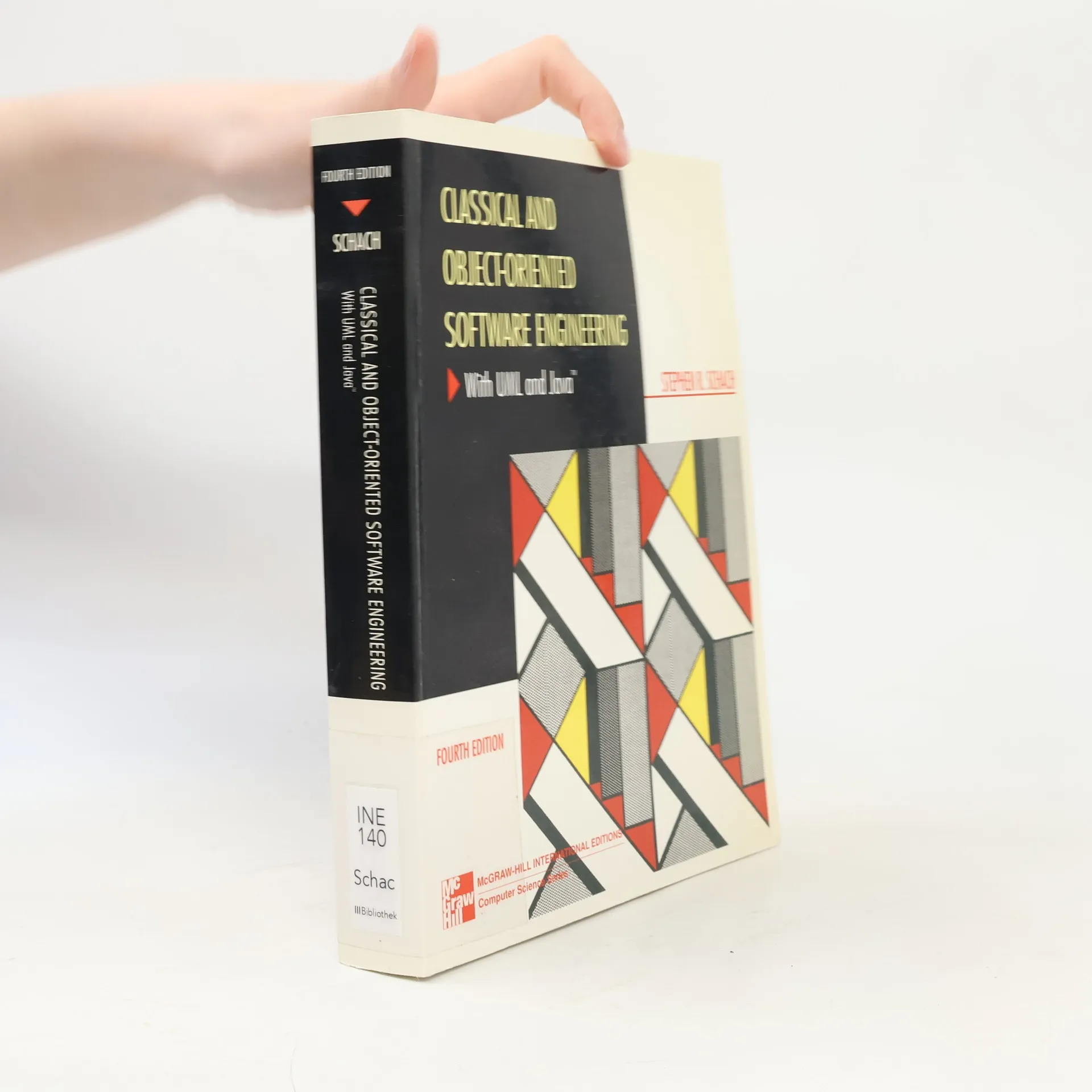

Classical and Object-Oriented Software Engineering
With UML and Java - Fourth Edition
- 648 stránek
- 23 hodin čtení
This text provides an introduction to the process of software engineering. The Universal Modeling Language (UML) has become an industry standard and now permeates this first edition. In this text, it is used for object-oriented analysis and design as well as when diagrams depict objects and their interrelationships. Design patterns, frameworks and software architecture have also become a popular topic in the field of software engineering and are part of a chapter on reuse, portability, and inoperability. The inoperabilty material includes sections on such hot topics as OLE, COM, and CORBA (you'll want to mention that this material is covered). THE DIFFERENCE BETWEEN THE SCHACH C++ AND JAVA BOOKS. These two books are completely identical in topic coverage, organization, and pedagogy. Even the pagingation of the two books is the same. While there is minimal computer code in either book, the difference is that where there is code, it is in C++ in one book and Java in the other. It is important to note that software engineering is independent of any specific programming language and your software engineering professors will likely emphasize this with you. But a specific language needs to be used to give examples and implement case studies -- these are done in C++ in one version and Java in the other.
Aufgrund der rückläufigen Baukonjunktur in Deutschland versuchen viele Bauunternehmen, Geschäftsfelder im Ausland zu erschließen. In diesem Buch werden Möglichkeiten zur Identifikation, Steuerung und Bewertung von Risiken bei internationalen Bauprojekten aufgezeigt. Verschiedene Möglichkeit der Risikoquantifizierung werden vorgestellt und anhand einer Monte Carlo Simulation vertieft.