

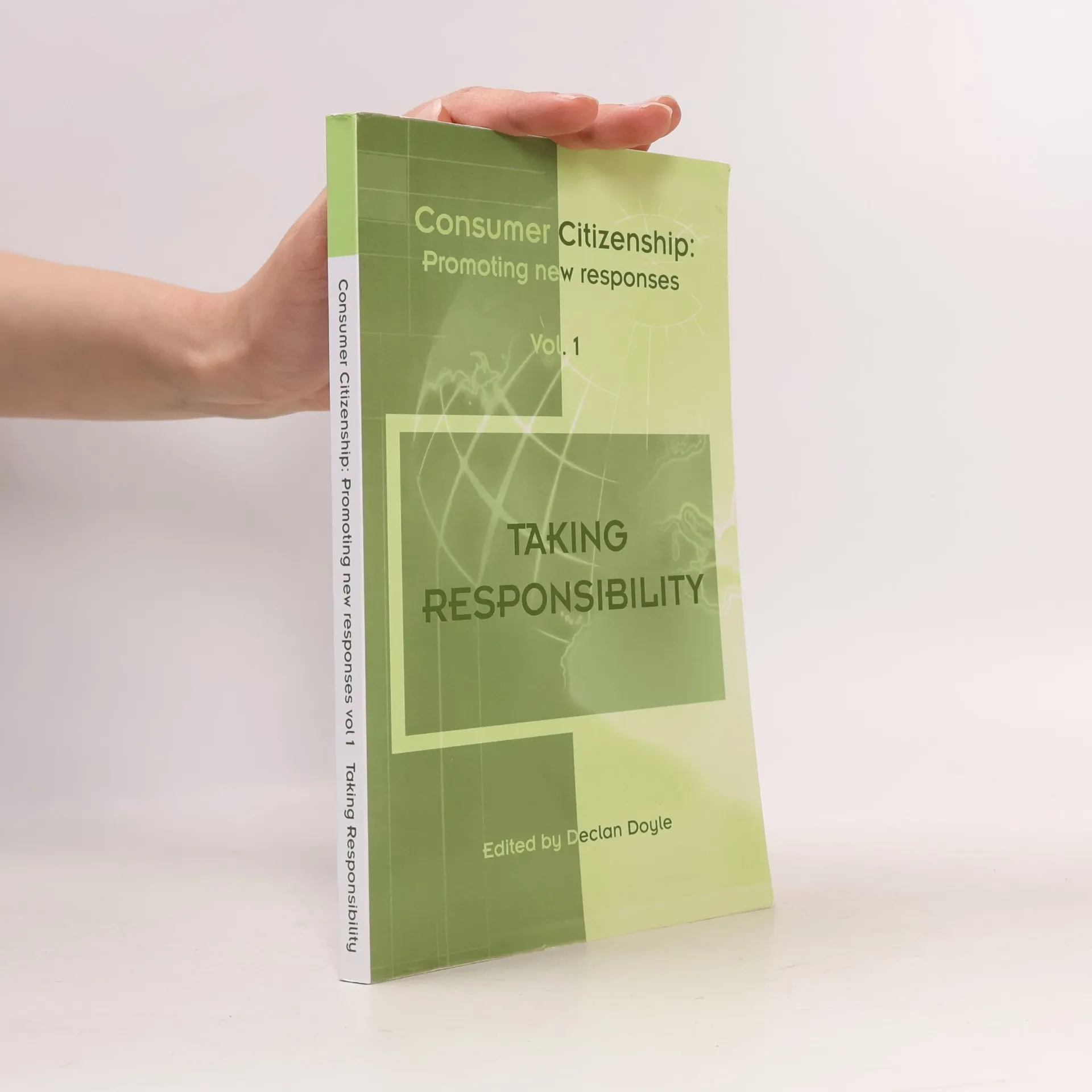
The nature of 'responsibility' and the various definitions of 'responsibility' are numerous. A simple web-search for the term 'responsibility' yields 349,000,000 hits! How can consumers be educated into taking responsibility if the term itself is so vague. A dictionary definition suggests that responsibility is a 'duty, obligation, or burden'. Yet some of the examples contained within this collection show that the taking of responsibility need not be a burden; though it may be a duty and may become an obligation. One dictionary defines responsibility as 'the social force that binds you to your obligations and the courses of action demanded by that force'. These papers form part of the debate on the courses of action demanded by a prevalent social force today. This force is leading us towards demanding a sustainable future, one in which all consumer citizens play an active part in determining the social and ecological landscape we are shaping for ourselves and future generations. We, as educators, have an important role to play in guiding future consumer citizens and we must accept this responsibility also as our duty -- not as our burden.
Ezio Manzini Knihy

Design, When Everybody Designs
An Introduction to Design for Social Innovation
- 241 stránek
- 9 hodin čtení
In a changing world, everyone designs: each individual person and each collective subject, from enterprises to institutions, from communities to cities and regions, must define and enhance a life project. Sometimes these projects generate unprecedented solutions; sometimes they converge on common goals and realize larger transformations. As Ezio Manzini describes in this book, we are witnessing a wave of social innovations as these changes unfold - an expansive open co-design process in which new solutions are suggested and new meanings are created. Manzini distinguishes between diffuse design (performed by everybody) and expert design (performed by those who have been trained as designers) and describes how they inteact. He maps what design experts can do to trigger and support meaningful social changes, focusing on emerging forms of collaboration. These range from community-supported argiculture in China to digital platforms for medical care in Canada; from interactive storytelling in India to collaborative housing in Milan. These cases illustrate how expert designers can support such collaborations - making their existence more probable, their practice easer, their diffusion and their convergence in larger projects more effective. Manzini draws the first comprehensive picture of design for social innovation: the most dynamic field of action for both expert and nonexpert designers in the coming decades. -- from dust jacket