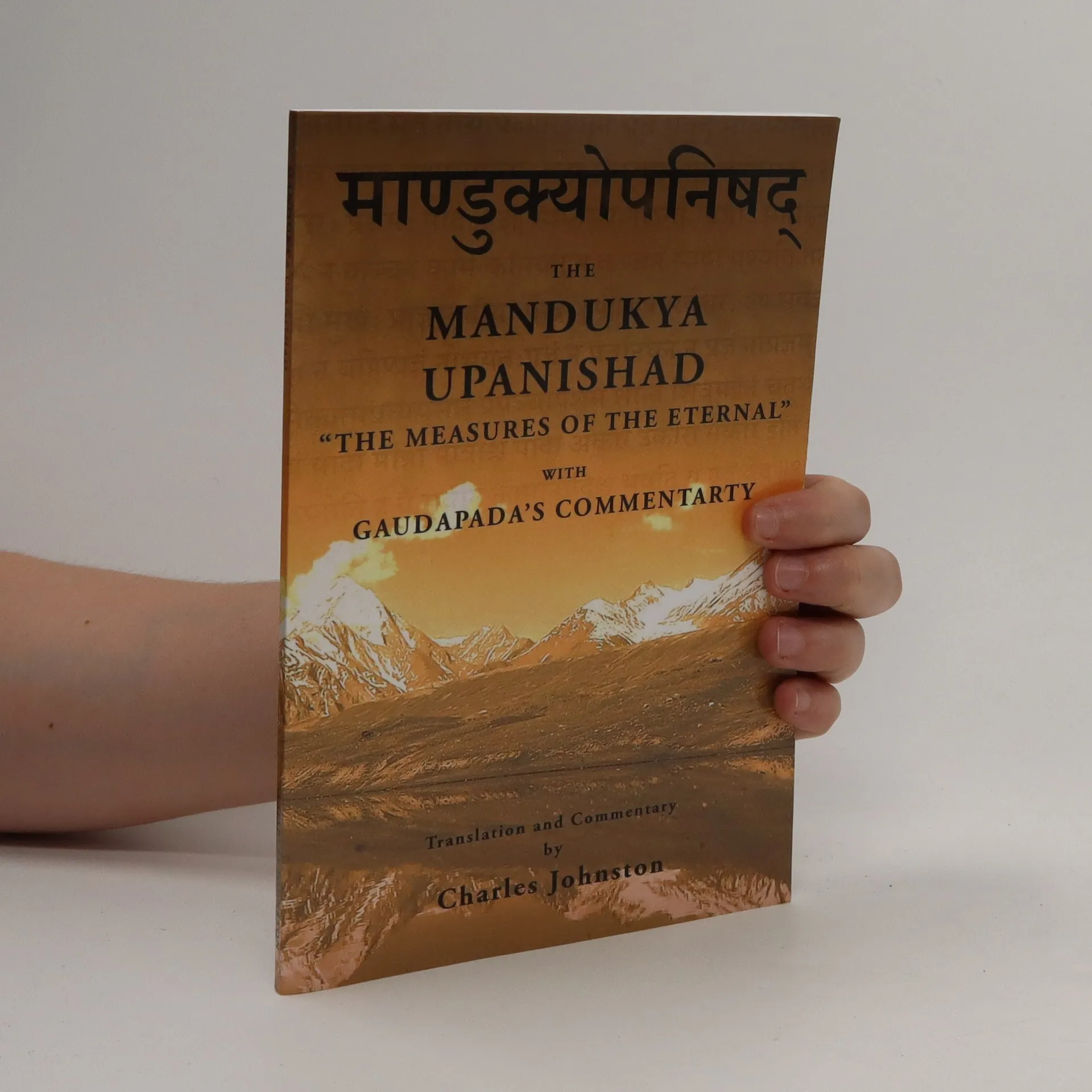
Rooted in the Taittiriya school of the Yajurveda, this Upanishad comprises the seventh, eighth, and ninth chapters of the Taittiriya Aräyaka, known as Siksavalli, Anandavalli, and Bh guvalli. It is part of the "black" Yajurveda, characterized by its unarranged collection of verses, contrasting with the "white" Yajurveda. The text is significant within the Muktika canon of 108 Upanishads and reflects the teachings attributed to the pupils of sage Vaishampayana, offering insights into ancient Indian philosophy and spirituality.
Charles Johnston Pořadí knih (chronologicky)
Charles Johnston byl hluboce ponořen do moudrosti východních tradic, což se odráží v jeho překladech klíčových filozofických děl. Jeho hluboké pochopení filozofie Védanty mu umožnilo odhalit podstatu Jógových súter Pataňdžaliho a zrod duchovního člověka. Johnstonova práce se zaměřuje na filozofické a teozofické otázky, přičemž čtenářům nabízí hluboký vhled do duchovních tradic Východu. Jeho přístup přibližuje čtenářům základní myšlenky těchto starověkých moudrostí srozumitelnou a přístupnou formou.


Focusing on the pursuit of Self-knowledge, this concise Sanskrit text by Adi Shankara outlines the journey towards understanding Atman, or the true self. It emphasizes the importance of self-awareness and the possession of knowledge regarding the soul and supreme spirit. Additionally, it serves as an introductory guide to Vedanta philosophy, encapsulating essential truths in a compact format.
The Katha Upanishad presents a profound dialogue between the young boy Nachiketa and Yama, the deity of death, exploring fundamental themes such as the nature of humanity, the essence of the self (Atman), and the concept of liberation (moksha). As one of the principal Upanishads, it delves into spiritual teachings that are central to Hindu philosophy, emphasizing the quest for knowledge and understanding of existence. This text remains a cornerstone of Vedic literature and continues to influence spiritual thought in Hinduism.
Focusing on spiritual teachings, the Upanishads are revered texts within Hinduism that delve into profound philosophical concepts. Comprising around 108 texts, the earliest and most significant are known as the principal Upanishads, which form the foundation of Hindu thought. These late Vedic Sanskrit writings explore the nature of reality, the self, and the universe, making them central to understanding Hindu spirituality and philosophy.
Tao Te Ching
Esoteric Classics: Eastern Studies
The book presents a translation of a foundational sixth-century B.C. text of Chinese Taoism by renowned translator Charles Johnston. It delves into Eastern spiritual and religious themes, providing readers with insights into the philosophical underpinnings of Taoism through Johnston's adept interpretation. This work serves as a bridge to understanding ancient wisdom and its relevance in contemporary spiritual practices.
Central to Hindu spirituality, the Upanishads are revered late Vedic texts that explore profound religious teachings and ideas. Among the approximately 108 known Upanishads, the earliest and most significant are termed the principal Upanishads. The Kena Upanishad stands out for its exploration of Brahman, both with and without attributes, and serves as a treatise on "purely conceptual knowledge," highlighting its philosophical depth and significance within the broader context of Hindu thought.
Tao Teh Ching
- 116 stránek
- 5 hodin čtení
Contains the same material as the 1961 printing published by St. John's University Press with the exception that the Chinese version of the text has been removed.
The Mandukya Upanishad
- 104 stránek
- 4 hodiny čtení
Charles Johnston's classic translation and commentary on one of the most profound of ancient sacred texts. The book also contains three introductory articles by Johnston, which shed much light on the Upanishads, their place in history, their influence and connection to other spiritual philosophies of the world. "The shortest of all the older Upanishads is the Mandukya. Yet in some ways it contains fuller and deeper teaching than any other of these wonderful treatises of the Mysteries. For the theme of the Mandukya is the four degrees of consciousness, the Natural, the Psychical, the Spiritual, and the Divine, which make up the whole range of life, both manifested and unmanifested. Every word of this Upanishad is brimful of history, brimful of thought. . . . "A single principle links together the great Upanishads and their diverse parts, like jewels strung on a golden thread: the oneness of the Soul and the Oversoul. When we have found the Soul, our inmost real Self, we have thereby found the Oversoul, the Supreme Self of all Being. This is the goal."-Charles Johnston
The Tao Te Ching
- 78 stránek
- 3 hodiny čtení
The Tao Teh King (Tao Te Ching) forms the fundamental core of modern Taoist philosophy and has informed the beliefs and mode of life of the people of China for 2500 years. For all those who seek peace, contentment, harmony and balance in life, the Tao Teh King is an indispensable resource. Lao Tse's words speak directly to the heart with simple, direct and profound wisdom addressing the core principles of the art of living well.The translation and commentary presented here was completed between 1921 and 1923 and serialized in the periodical magazine The Theosophical Quarterly. The society responsible for the periodical was dissolved some fifteen years later, leaving this translation to lay dormant these many years. It is reproduced verbatim, but with an adjustment in formatting-providing the translation itself, in whole, prior to the commentary-the addition of a foreword, and of additional notes.Charles Johnston's article on the Religion of China, reproduced in this volume, demonstrates the depth of his understanding not only of Ancient China and its religious life, but of its place in the larger context of human religious thought. This wider contextual grasp lends itself to a much more expansive commentary upon the Tao Teh King than we commonly find, as Johnston is able to draw many parallels to other world-teachings, some of which the student may be more intimately familiar.
Puškin ve svém slavném veršovaném románu popisuje ruskou společnost 1. poloviny 19. století ve městě i na venkově. s lehkostí a ironickým nadhledem líčí všednodenní náplň znuděného petrohradského dandyho Oněgina a jeho nešťastný milostný příběh s naivní a snivou Táňou. Román se stal nesmrtelnou klasikou světové literatury.