

Více o knize
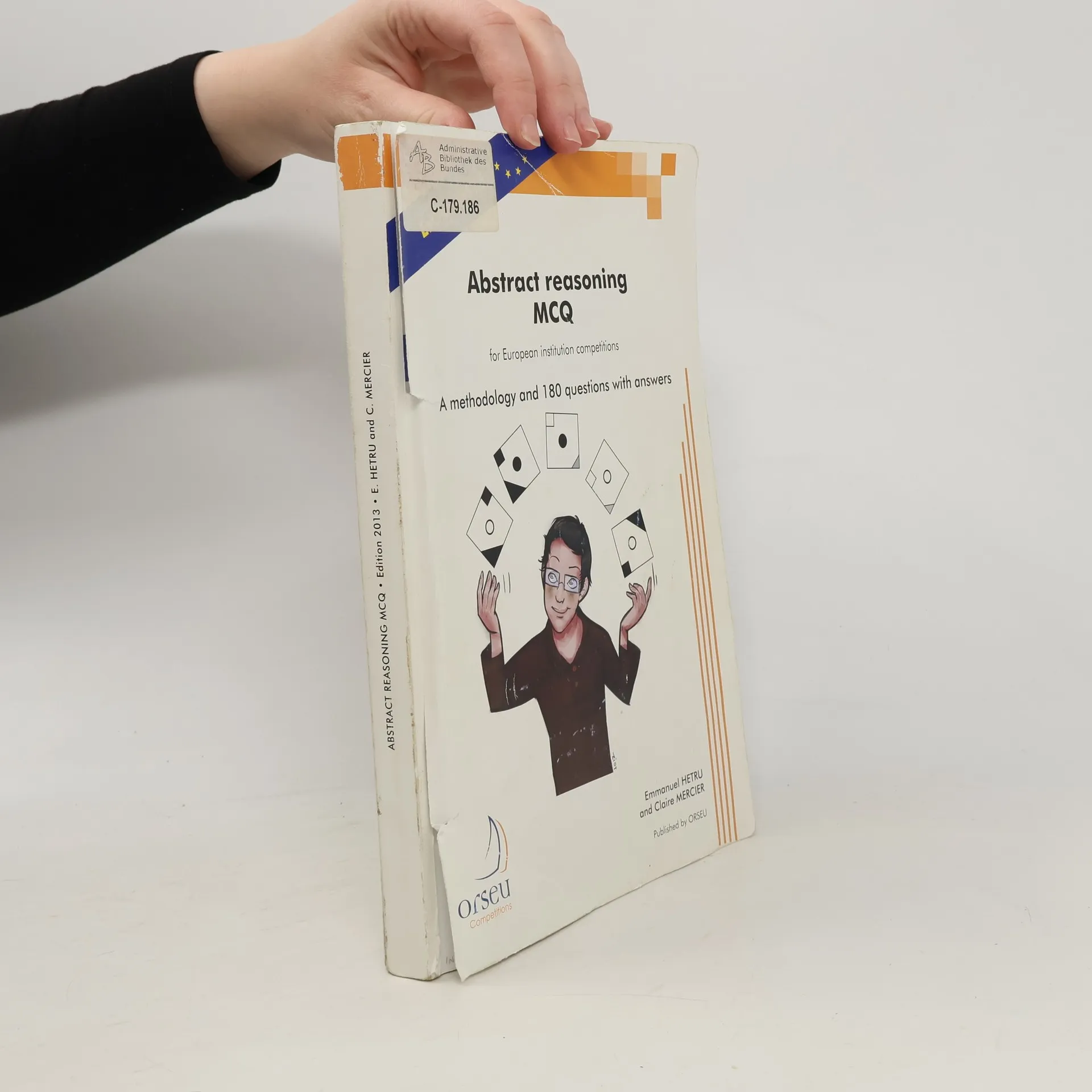
"This new, revised and expanded edition is aimed at all candidates planning to sit European institution competitions and who wish to prepare as effectively as possible for the abstract reasoning test. Abstract reasoning questions are presented as series of diagrams containing geometric shapes which are repeated or modified according to a logical sequence. Candidates have to identify the underlying logic and find the diagram that completes the series. Abstract reasoning tests call for skills that candidates do not normally use in everyday life: the ability to visualise geometric transformations (rotations, symmetries, etc), an aptitude to spot similarities between complex shapes, etc. We are all capable of developing these skills."--Publisher.
Vydání

Nákup knihy
Abstract Reasoning MCQ for European Institution Competitions, Emmanuel Hetru
- Jazyk

- Rok vydání
- 2013
- Vazba
- (měkká)
Doručení
Platební metody
Nikdo zatím neohodnotil.
- Titul
- Abstract Reasoning MCQ for European Institution Competitions
- Podtitul
- A Methodology and 180 Questions with Answers
- Jazyk
- anglicky
- Autoři
- Emmanuel Hetru
- Vydavatel
- Orseu
- Rok vydání
- 2013
- Vazba
- měkká
- Počet stran
- 287
- ISBN10
- 2918796484
- ISBN13
- 9782918796480
- Série
- Kategorie
- Anotace
- "This new, revised and expanded edition is aimed at all candidates planning to sit European institution competitions and who wish to prepare as effectively as possible for the abstract reasoning test. Abstract reasoning questions are presented as series of diagrams containing geometric shapes which are repeated or modified according to a logical sequence. Candidates have to identify the underlying logic and find the diagram that completes the series. Abstract reasoning tests call for skills that candidates do not normally use in everyday life: the ability to visualise geometric transformations (rotations, symmetries, etc), an aptitude to spot similarities between complex shapes, etc. We are all capable of developing these skills."--Publisher.