



Parametry
Více o knize
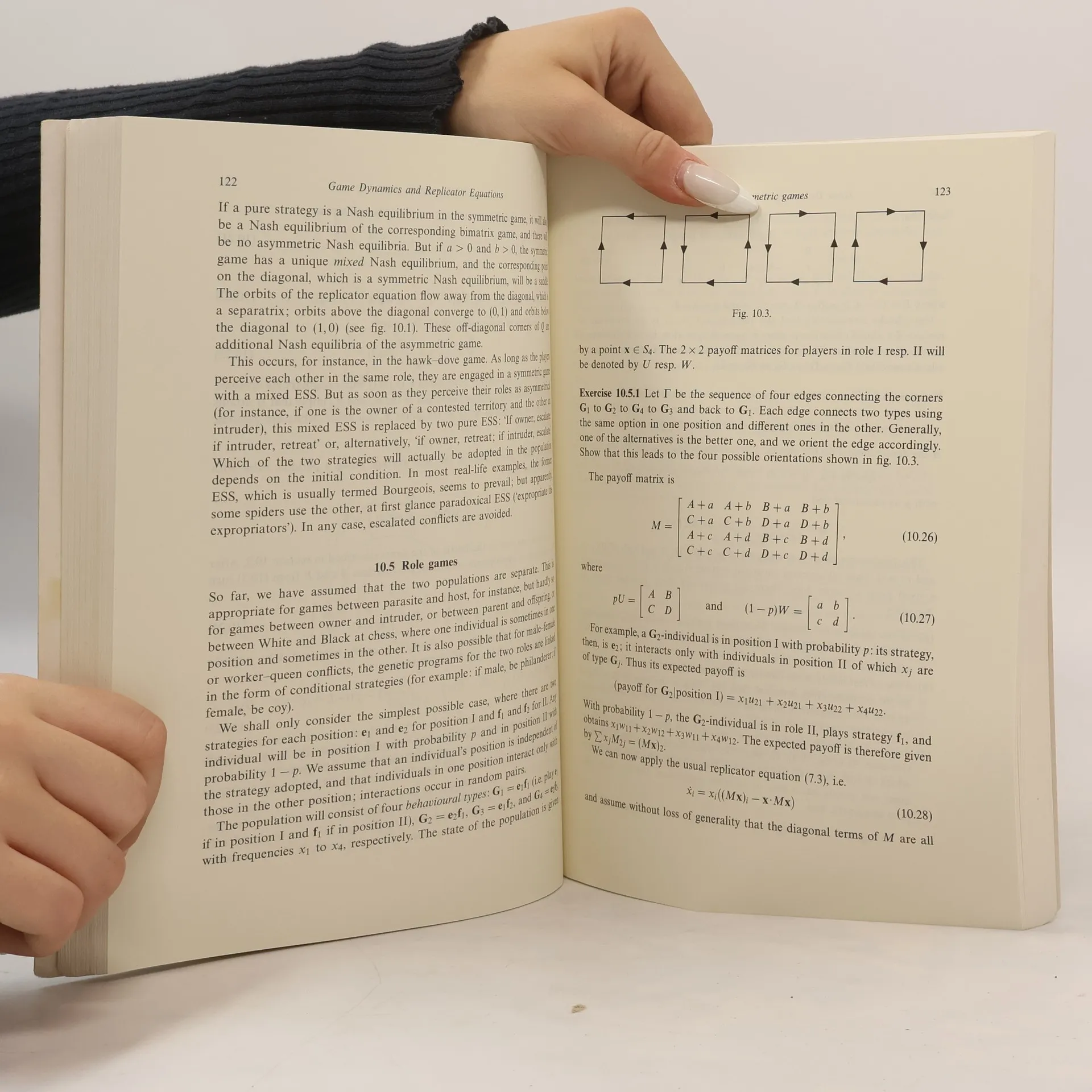
Every form of behavior is shaped by trial and error. Such stepwise adaptation can occur through individual learning or through natural selection, the basis of evolution. Since the work of Maynard Smith and others, it has been realized how game theory can model this process. Evolutionary game theory replaces the static solutions of classical game theory by a dynamical approach centered not on the concept of rational players but on the population dynamics of behavioral programs. In this book the authors investigate the nonlinear dynamics of the self-regulation of social and economic behavior, and of the closely related interactions among species in ecological communities. Replicator equations describe how successful strategies spread and thereby create new conditions that can alter the basis of their success, i.e., to enable us to understand the strategic and genetic foundations of the endless chronicle of invasions and extinctions that punctuate evolution. In short, evolutionary game theory describes when to escalate a conflict, how to elicit cooperation, why to expect a balance of the sexes, and how to understand natural selection in mathematical terms.
Nákup knihy
Evolutionary Games and Population Dynamics, Josef Hofbauer, Karl Sigmund
- Jazyk

- Rok vydání
- 1998
- Vazba
- (měkká)
Doručení
Platební metody
Tady nám chybí tvá recenze.
- Titul
- Evolutionary Games and Population Dynamics
- Jazyk
- anglicky
- Autoři
- Josef Hofbauer, Karl Sigmund
- Vydavatel
- Cambridge University Press
- Rok vydání
- 1998
- Vazba
- měkká
- ISBN10
- 052162570X
- ISBN13
- 9780521625708
- Série
- Štítky
- Hodnocení
- 4 z 5
- Anotace
- Every form of behavior is shaped by trial and error. Such stepwise adaptation can occur through individual learning or through natural selection, the basis of evolution. Since the work of Maynard Smith and others, it has been realized how game theory can model this process. Evolutionary game theory replaces the static solutions of classical game theory by a dynamical approach centered not on the concept of rational players but on the population dynamics of behavioral programs. In this book the authors investigate the nonlinear dynamics of the self-regulation of social and economic behavior, and of the closely related interactions among species in ecological communities. Replicator equations describe how successful strategies spread and thereby create new conditions that can alter the basis of their success, i.e., to enable us to understand the strategic and genetic foundations of the endless chronicle of invasions and extinctions that punctuate evolution. In short, evolutionary game theory describes when to escalate a conflict, how to elicit cooperation, why to expect a balance of the sexes, and how to understand natural selection in mathematical terms.