


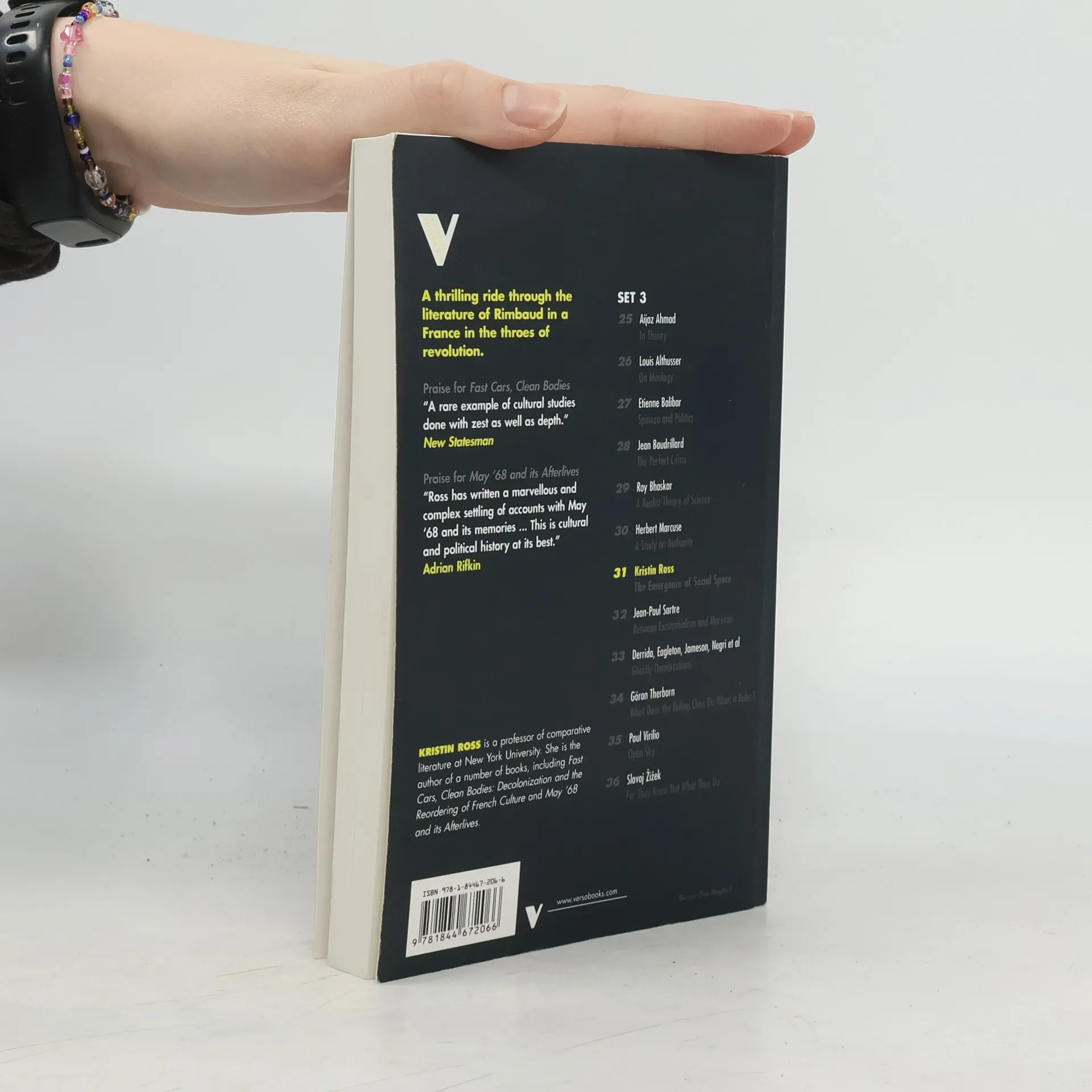

Radical Thinkers - 31: The Emergence of Social Space
Rimbaud and the Paris Commune
Autoři
Hodnocení knihy
Více o knize
The 1870s in France, a decade often overlooked in standard histories, was marked by significant spatial events: France's global expansion and the brief existence of the Paris Commune in spring 1871, which represented a revolutionary urban space. Kristen Ross argues that space is inherently political and strategic, crafting a narrative that intertwines history and geography of the Commune’s anarchist culture, including its political language, social relations, values, and strategies. Central to her analysis is a close reading of Arthur Rimbaud’s poetry, which serves as a common thread throughout the book, representing one of many documents that recreate the Communard experience. Figures like Rimbaud, Paul Lafargue, and social geographer Elisee Reclus emerge as emblematic of the Commune, challenging the capitalist conception of work and identity, thus threatening the existing order. Ross explores these emancipatory notions as integral to Communard life, each reflecting a parallel strategy in Rimbaud’s poetry. By applying contemporary theory to a wealth of lesser-known archival materials, she presents a fresh, persuasive, and original perspective on this pivotal moment in French history.
Nákup knihy
Radical Thinkers - 31: The Emergence of Social Space, Kristin Ross
- Jazyk

- Rok vydání
- 2008
- Vazba
- (měkká)
Doručení
Platební metody
Tady nám chybí tvá recenze.
- Titul
- Radical Thinkers - 31: The Emergence of Social Space
- Podtitul
- Rimbaud and the Paris Commune
- Jazyk
- anglicky
- Autoři
- Kristin Ross
- Vydavatel
- Verso Books
- Rok vydání
- 2008
- Vazba
- měkká
- Počet stran
- 190
- ISBN10
- 1844672069
- ISBN13
- 9781844672066
- Série
- Štítky
- Filosofická tématika
- Hodnocení
- 3,9 z 5
- Anotace
- The 1870s in France, a decade often overlooked in standard histories, was marked by significant spatial events: France's global expansion and the brief existence of the Paris Commune in spring 1871, which represented a revolutionary urban space. Kristen Ross argues that space is inherently political and strategic, crafting a narrative that intertwines history and geography of the Commune’s anarchist culture, including its political language, social relations, values, and strategies. Central to her analysis is a close reading of Arthur Rimbaud’s poetry, which serves as a common thread throughout the book, representing one of many documents that recreate the Communard experience. Figures like Rimbaud, Paul Lafargue, and social geographer Elisee Reclus emerge as emblematic of the Commune, challenging the capitalist conception of work and identity, thus threatening the existing order. Ross explores these emancipatory notions as integral to Communard life, each reflecting a parallel strategy in Rimbaud’s poetry. By applying contemporary theory to a wealth of lesser-known archival materials, she presents a fresh, persuasive, and original perspective on this pivotal moment in French history.