



Více o knize
In May 1930, the Council of Trinity College, Cambridge, sought Bertrand Russell's assessment to decide on renewing Wittgenstein's research grant. Russell noted the originality and importance of Wittgenstein's new work, suggesting it might lead to a new philosophy, despite his uncertainty about its truth. The text contains foundational elements of Wittgenstein's later thoughts on mind and mathematics. It critiques Russell's "The Analysis of Mind" and revises the picture theory of meaning from the "Tractatus," emphasizing that the link between propositions and reality is not inherent in the picture itself. Wittgenstein explores generality in mathematics, the concepts of proof and experiment, and presents a pain/private-language argument while addressing behaviorism and the verifiability principle. Though challenging, this work is crucial for any philosophy collection. It serves as a key transitional text between Wittgenstein's major works, making it essential for those aiming for a comprehensive understanding of his philosophy.


Nákup knihy
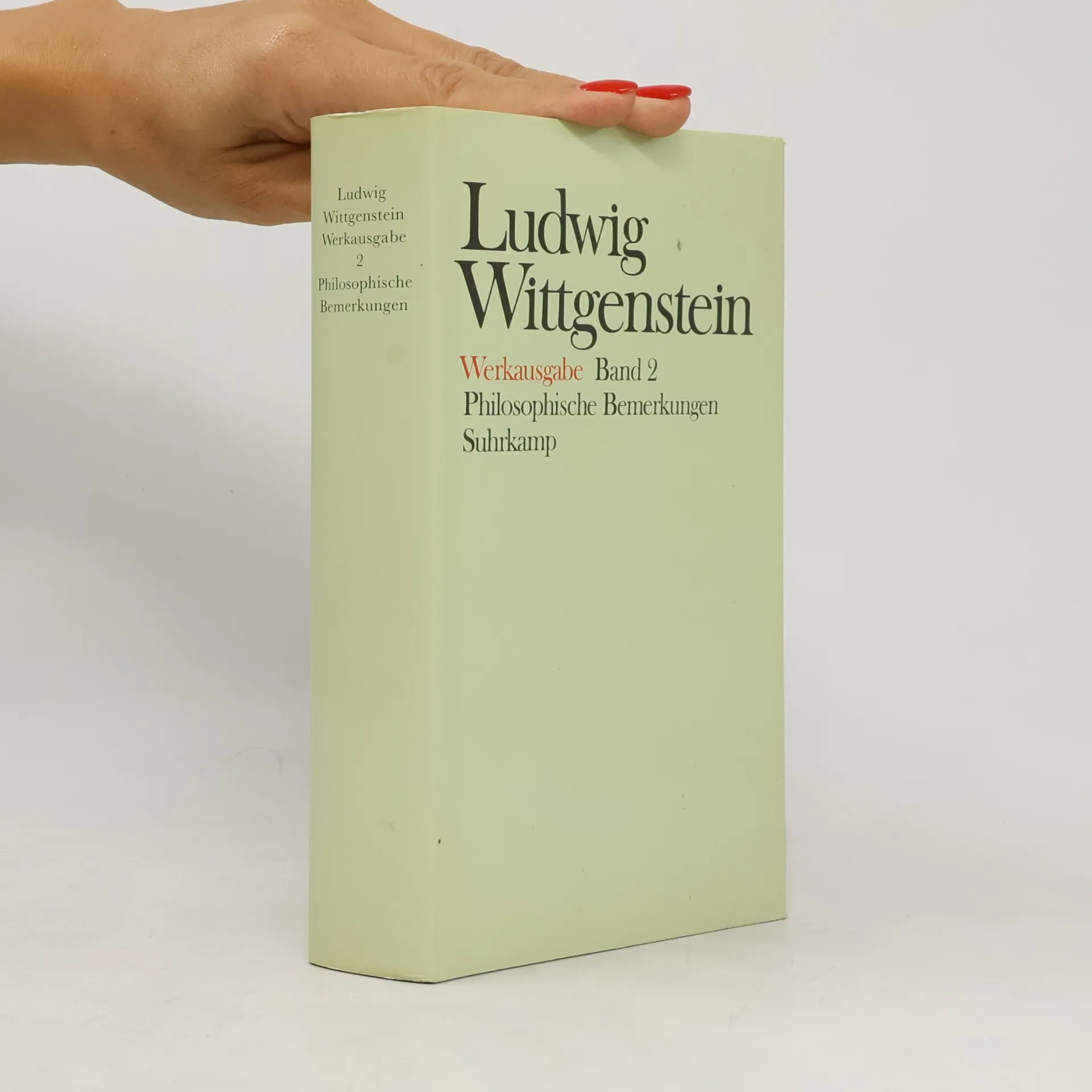
Werkausgabe - 2: Philosophische Bemerkungen, Ludwig Wittgenstein
- Jazyk

- Rok vydání
- 1989
- Vazba
- (pevná),
- Stav knihy
- Dobrá
- Cena
- 569 Kč
Tady nám chybí tvá recenze.
- Titul
- Werkausgabe - 2: Philosophische Bemerkungen
- Jazyk
- německy
- Autoři
- Ludwig Wittgenstein
- Vydavatel
- Suhrkamp
- Rok vydání
- 1989
- Vazba
- pevná
- Počet stran
- 319
- ISBN10
- 3518579908
- ISBN13
- 9783518579909
- Série
- Kategorie
- Štítky
- Filosofická tématika
- Hodnocení
- 3,8 z 5
- Anotace
- In May 1930, the Council of Trinity College, Cambridge, sought Bertrand Russell's assessment to decide on renewing Wittgenstein's research grant. Russell noted the originality and importance of Wittgenstein's new work, suggesting it might lead to a new philosophy, despite his uncertainty about its truth. The text contains foundational elements of Wittgenstein's later thoughts on mind and mathematics. It critiques Russell's "The Analysis of Mind" and revises the picture theory of meaning from the "Tractatus," emphasizing that the link between propositions and reality is not inherent in the picture itself. Wittgenstein explores generality in mathematics, the concepts of proof and experiment, and presents a pain/private-language argument while addressing behaviorism and the verifiability principle. Though challenging, this work is crucial for any philosophy collection. It serves as a key transitional text between Wittgenstein's major works, making it essential for those aiming for a comprehensive understanding of his philosophy.