

Miláček čtenářů je právě vyprodaný
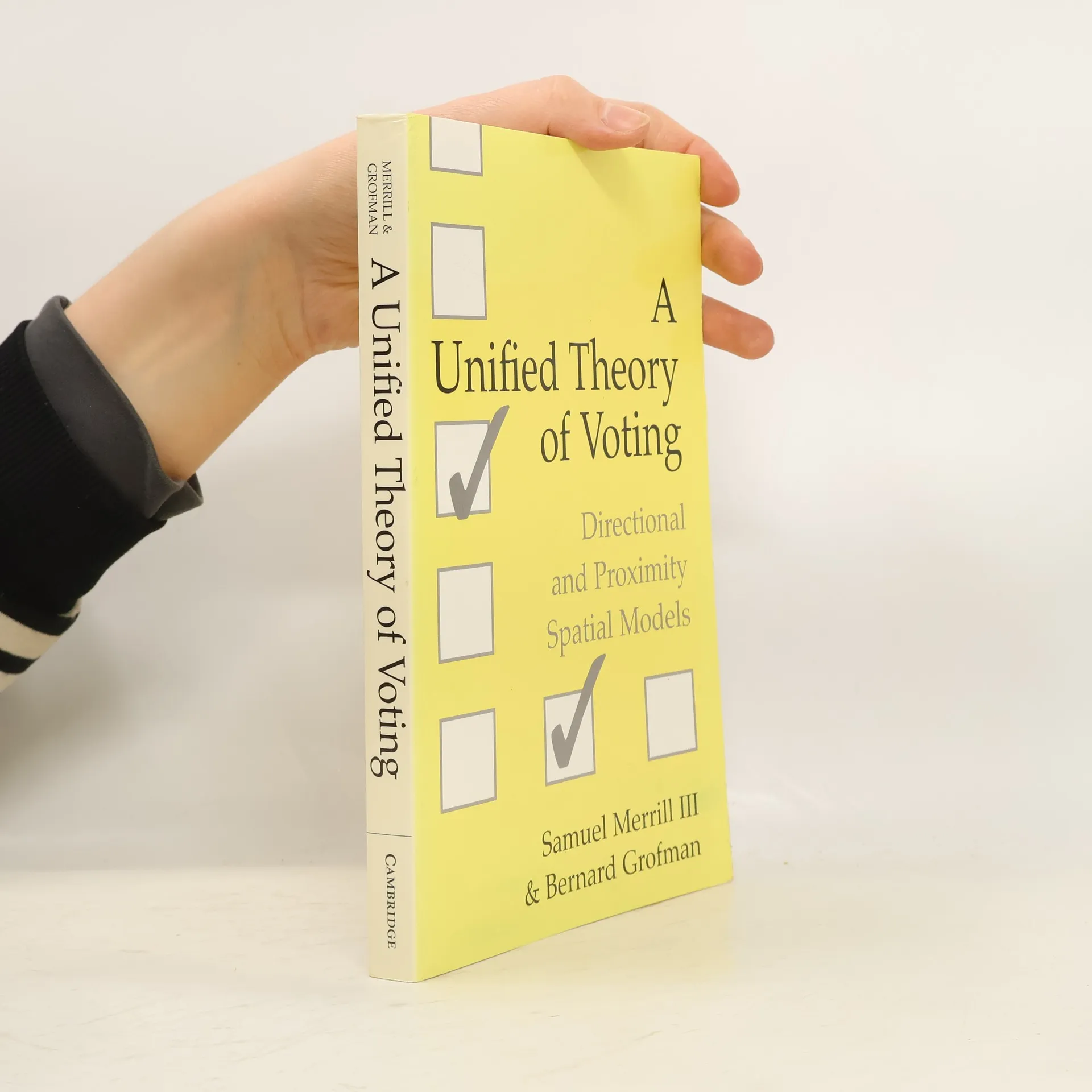


Více o knize
Professors Merrill and Grofman develop a unified model that incorporates voter motivations and assesses its empirical predictions--for both voter choice and candidate strategy--in the United States, Norway, and France. The analyses show that a combination of proximity, direction, discounting, and party ID are compatible with the mildly but not extremely divergent policies that are characteristic of many two-party and multiparty electorates. All of these motivations are necessary to understand the linkage between candidate issue positions and voter preferences.
Nákup knihy
A Unified Theory of Voting, Samuel Merrill, III, Bernard Grofman
- Jazyk

- Rok vydání
- 1999
- Vazba
- (měkká)
Jakmile se objeví, pošleme e-mail.
Doručení
Platební metody
Tady nám chybí tvá recenze.
- Titul
- A Unified Theory of Voting
- Podtitul
- Directional and Proximity Spatial Models
- Jazyk
- anglicky
- Vydavatel
- Cambridge University Press
- Rok vydání
- 1999
- Vazba
- měkká
- Počet stran
- 230
- ISBN10
- 0521665493
- ISBN13
- 9780521665490
- Série
- Štítky
- Politika, USA, Politické teorie
- Hodnocení
- 4 z 5
- Anotace
- Professors Merrill and Grofman develop a unified model that incorporates voter motivations and assesses its empirical predictions--for both voter choice and candidate strategy--in the United States, Norway, and France. The analyses show that a combination of proximity, direction, discounting, and party ID are compatible with the mildly but not extremely divergent policies that are characteristic of many two-party and multiparty electorates. All of these motivations are necessary to understand the linkage between candidate issue positions and voter preferences.