

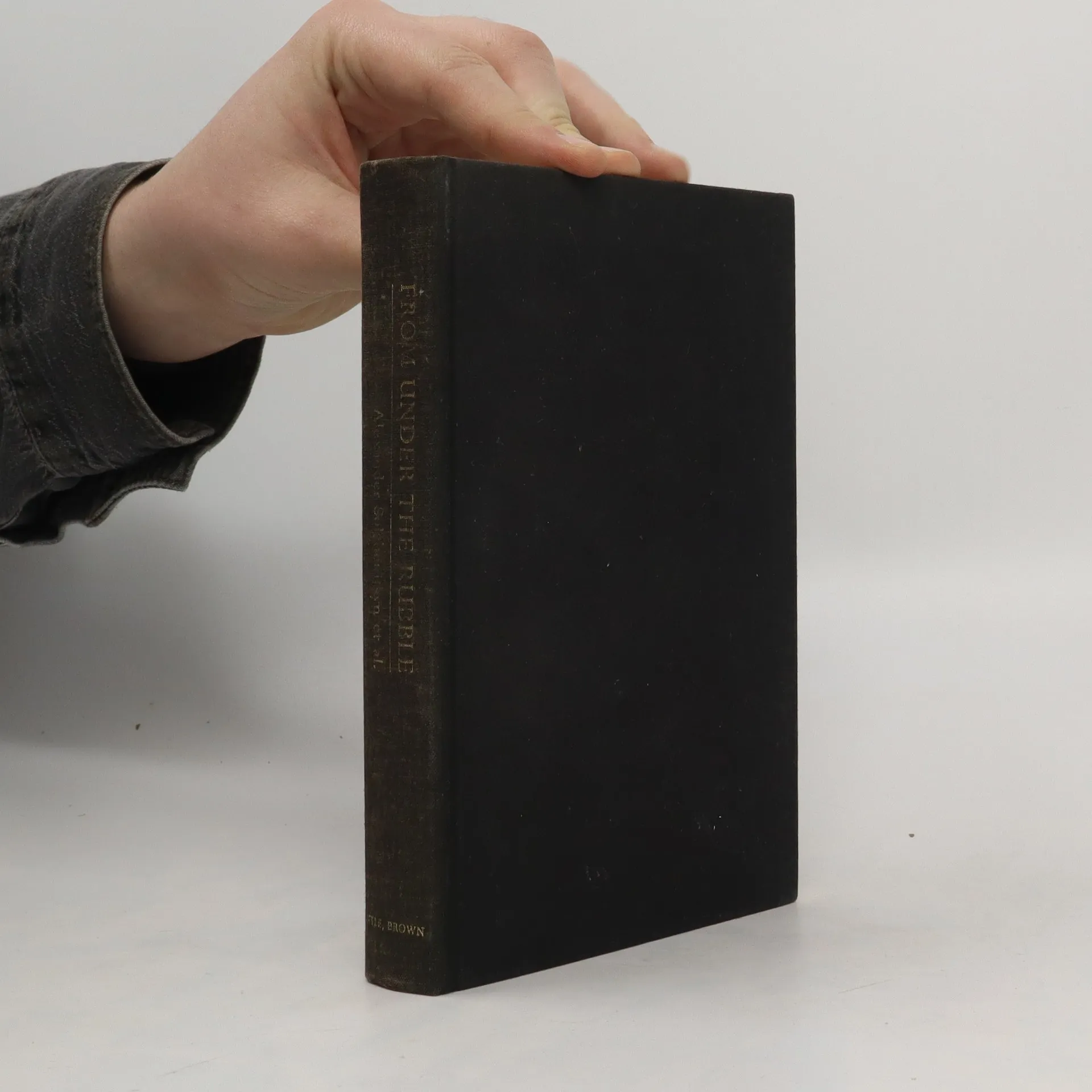
Alexander Solzhenitsyn and six dissident colleagues who at the time of publication were still living in the USSR — six men totally vulnerable to arrest, imprisonment, or execution by the Soviet authorities — joined in the midseventies to write a book which surely remains the most extraordinary debate of a nation’s future published in modern times. Shattering a half-century of silence, From Under the Rubble constitutes a devastating attack on the Soviet regime, a moral indictment of the liberal West, and a Christian manifesto calling for a new society — one whose dominant values would be spiritual rather than economic. Personally edited by the Nobel Prize-winning author, fired by his own substantial contributions, From Under the Rubble articulates Solzhenitsyn’s most fervent call to action. His daring, and the remarkable courage of his colleagues, is testament to the seriousness of their demand for a revolution in which one does not kill one’s enemies, but in which “one puts oneself in danger for the sake of the nation!” With an introduction by Max Hayward, and translated under the direction of Michael Scammell. The contributors: Alexander Solzhenitsyn, Mikhail Agursky, Evgeny Barabanov, Vadim Borisov, F. Korsakov, A.B., Igor Shafarevich.
Igor R. Shafarevich Knihy
Igor Rostislavovich Shafarevich byl ruský matematik s významnými příspěvky do algebraické teorie čísel a algebraické geometrie. Kromě své matematické práce byl také známý svými kritickými texty o socialismu, které jej v sovětském režimu etablovaly jako důležitou disidentskou postavu.

Linear Algebra and Geometry
- 548 stránek
- 20 hodin čtení
This book on linear algebra and geometry is based on a course given by renowned academician I.R. Shafarevich at Moscow State University. The book begins with the theory of linear algebraic equations and the basic elements of matrix theory and continues with vector spaces, linear transformations, inner product spaces, and the theory of affine and projective spaces. The book also includes some subjects that are naturally related to linear algebra but are usually not covered in such courses: exterior algebras, non-Euclidean geometry, topological properties of projective spaces, theory of quadrics (in affine and projective spaces), decomposition of finite abelian groups, and finitely generated periodic modules (similar to Jordan normal forms of linear operators). Mathematical reasoning, theorems, and concepts are illustrated with numerous examples from various fields of mathematics, including differential equations and differential geometry, as well as from mechanics and physics.