
Focusing on the life of a pioneering stage director, the narrative explores the complex history of China's Communist Party through the experiences of Sun Weishi. Educated in Moscow, she contributed significantly to Chinese theater by producing works by Chekov and Gogol. However, her artistic endeavors led to persecution during the Cultural Revolution, culminating in her arrest and tragic death in prison. The novel captures the struggles of a remarkable woman against the backdrop of a tumultuous political landscape.
Ein »verbannter Unsterblicher« wurde Li Bai (701–762) schon zu Lebzeiten genannt: In der offiziellen chinesischen Literatur kaum gewürdigt, erlangten seine Gedichte, die von daoistischem Gedankengut geprägt sind und sich durch Leidenschaft und Lebenslust auszeichnen, bereits in der gesamten Tang-Dynastie über die Rezitationen von Hofunterhaltern, Tavernensängern, Soldaten und Schriftstellern großen Ruhm und landesweite Verbreitung. Noch heute werden seine von tiefer Sehnsucht nach einer höheren, vollkommeneren Welt geprägten Verse chinesischen Schulkindern beigebracht und bei Festen als Trinksprüche aufgesagt; längst sind sie untrennbarer Teil der chinesischen Sprache. Doch wer war dieser Jahrtausenddichter? Mit seinem Gespür eines meisterhaften Romanciers gelingt es Ha Jin, aus den uns überlieferten historischen und literarischen Quellen die Lebensgeschichte des großen Dichters als ein Porträt seiner Zeit zu erzählen. Er folgt Li Bai von seiner Kindheit an der westlichen Grenze bis hin zu seinen Wanderungen als junger Mann, die von Strebsamkeit, aber auch von fröhlicher Unbekümmertheit und lustvollen Ausschweifungen geprägt waren. Er folgt dem Dichter durch seine späten Jahre, in denen er in eine umwälzende militärische Rebellion verwickelt wurde, die den Lauf der chinesischen Geschichte veränderte – und erzählt von den mysteriösen und von Legenden umrankten Umständen seines Todes.
From the universally admired, National Book Award-winning, bestselling author of Waiting—a timely novel that follows a famous Chinese singer severed from his country, as he works to find his way in the United States At the end of a U.S. tour with his state-supported choir, popular singer Yao Tian takes a private gig in New York to pick up some extra cash for his daughter’s tuition fund, but the consequences of his choice spiral out of control. On his return to China, Tian is informed that the sponsors of the event were supporters of Taiwan’s secession, and that he must deliver a formal self-criticism. When he is asked to forfeit his passport to his employer, Tian impulsively decides instead to return to New York to protest the government’s threat to his artistic integrity. With the help of his old friend Yabin, Tian’s career begins to flourish in the United States. But he is soon placed on a Chinese government blacklist and thwarted by the state at every turn, and it becomes increasingly clear that he may never return to China unless he denounces the freedoms that have made his new life possible. Tian nevertheless insists on his identity as a performer, refusing to give up his art. Moving, important, and strikingly relevant to our times, A Song Everlasting is a story of hope in the face of hardship from one of our most celebrated authors.
"From the National Book Award-winning author of Waiting: a narratively driven, deeply human biography of the Tang dynasty poet Li Bai, also known as Li Po. In his own time (701-762), Li Bai's poems--shaped by Daoist thought and characterized by their passion, romance, and lust for life--were never given their proper due by the official literary gatekeepers. Nonetheless, his lines rang out on the lips of court entertainers, tavern singers, soldiers, and writers throughout the Tang dynasty, and his deep desire for a higher, more perfect world gave rise to his nickname, the Banished Immortal. Today, Bai's verses are still taught to China's schoolchildren and recited at parties and toasts; they remain an inextricable part of the Chinese language. With the instincts of a master novelist, Ha Jin draws on a wide range of historical and literary sources to weave the great poet's life story. He follows Bai from his origins on the western frontier to his rambling travels as a young man, which were filled with striving but also with merry abandon, as he raised cups of wine with friends and fellow poets. Ha Jin also takes us through the poet's later years--in which he became swept up in a military rebellion that altered the course of China's history--and the mysterious circumstances of his death, which are surrounded by legend. [This book] is an extraordinary portrait of a poet who both transcended his time and was shaped by it, and whose ability to live, love, and mourn without reservation produced some of the most enduring verses."--Dust jacket
The poetry of Ha Jin delves into China's complex political history, offering a bold exploration of its challenges. Simultaneously, it honors the nation's rich cultural heritage and stunning landscapes, creating a profound connection between the past and present. Through vivid imagery and poignant themes, the collection reflects on the interplay of personal and national identity in a rapidly changing world.
Der einzigartige Weg einer professionellen Go-Spielerin
„Ich begrüßte freudig meine Mitspieler und setzte mich an den Platz mit meinem Namensschild. Das Brett vor mir war leer und blank. Neben dem Brett zeigte eine silbrige Digitaluhr drei Stunden plus fünfmal sechzig Sekunden Zeitzuschlag pro Spieler an. Als ich auf das leere Holzbrett blickte, war mir plötzlich, als schaute das Brett mich fragend an: „Wo warst du denn?“ Ich wusste nicht, was ich sagen sollte.“ Die Stimme einer bemerkenswerten jungen Frau erzählt uns in diesen Texten vom Leben einer erfolgreichen professionellen Go-Spielerin, und dann von ihrem Weg in ein anderes, facettenreicheres Leben. Dieses Buch ist eine Sammlung von Aufsätzen und Betrachtungen, die sehr klar geschrieben und leicht und bereichernd zu lesen sind. Go ist das komplexeste Spiel, das die Menschheit hervorgebracht hat. Es kam vor etwa 4000 Jahren in China ans Licht der Welt. So wie die Schrift wurde auch die Kunst des Go-Spiels früh nach Korea importiert (wo es Baduk genannt wird), und gelangte von dort nach Japan. Während in Japan bereits im 17. Jahrhundert professionelle Strukturen entstanden, etablierte sich in Korea ein Profi-System erst sehr spät, in der zweiten Hälfte des 20. Jahrhunderts. Es brachte eine Vielzahl starker Spieler hervor, und mit ihm veränderte sich auch die Art und die Qualität des Go-Spiels.
A delicious satire. . . . One of the most unsettling books about the moral
dimensions of modern journalism. -The Washington Post Both entertaining and
thought-provoking. . . . A powerful vehicle for the truths of our times. -The
Boston Globe It feels like a miracle-and a splendid irony-that an immigrant
writer can fashion a novel with such quintessentially American themes from the
front lines of the Chinese diaspora. -The Seattle Times Savage satire. . . .
[Ha Jin] is a writer of simple yet powerful gifts. -The New York Times Book
Review Arguably Ha Jin's most political-and funny-novel yet. -New York
Convincing as well as timely. . . . [Has] a powerful moral core. -The
Christian Science Monitor The narrative framework is fertile ground for Jin's
brilliant and nuanced political and social observations. -The Seattle Times
Jin's criticism of modern-day Communist China is stunning, easily the best
part of an already well-crafted novel. I was reminded of 1984 and the passages
Winston and Julia read aloud from The Theory and Practice of Oligarchical
Collectivism. -Nandini Balial, Los Angeles Review of Books Ha Jin only gets
better and better. In The Boat Rocker he continues with his supply of
unadorned prose, as evocative as Chekhov's. . . . But he also draws us, so
gently that we hardly notice, into some very deep questions, first about
Chinese-American identity, then about identity for any person, and then about
the value and the risks, for anyone, of living with integrity. -Perry Link
Page-turning but profound. . . . The twists and turns of Danlin's fight with
Haili make The Boat Rocker a compelling read, but Jin's insight into
nationalism, patriotism and the true cost of freedom of the press gives the
novel depth and brilliance. -BookPage Jin's conceit is intriguing, even
ingenious, and he dazzles with every scene in which his reporter is confronted
by hostile forces. . . . Bracing and absorbing, at its heart lurks a chilling
message: 'Truth depends on how you shape and present it.' -The National Laugh-
out-loud funny while being as illuminating as ever. -Kirkus Reviews (starred)
National Book Award-winning Ha Jin uses sly, black humor to underscore the
high price of integrity, the consequences of betrayal, and the power of the
written word. -Library Journal (starred review) Takes aim at exploitative
novels and international relations. . . . Ha Jin's prose is always pleasurable
to read. -Publishers Weekly
A Christian Science Monitor Best Book of the Year Lilian Shang, a history professor in Maryland, knew that her father, Gary, had been the most important Chinese spy ever caught in the United States. But when she discovers his diary after the death of her parents, its pages reveal the full pain and longing that his double life entailed—and point to a hidden second family that he’d left behind in China. As Lilian follows her father’s trail back into the Chinese provinces, she begins to grasp the extent of her father’s dilemma—torn between loyalty to his motherland and the love he came to feel for his adopted country. As she starts to understand that Gary, too, had been betrayed, she finds that it is up to her to prevent his tragedy from endangering yet another generation of the Shangs. A stunning portrait of a multinational family, an unflinching inquiry into the meaning of patriotism, A Map of Betrayal is a spy novel that only Ha Jin could write.
From the award-winning author of Waiting and War Trash: a riveting tale of espionage and conflicted loyalties that spans half a century in the entwined histories of two countries—China and the United States—and two families.When Lilian Shang, born and raised in America, discovers her father's diary after the death of her parents, she is shocked by the secrets it contains. She knew that her father, Gary, convicted decades ago of being a mole in the CIA, was the most important Chinese spy ever caught. But his diary - an astonishing chronicle of his journey from 1949 Shanghai to Okinawa to Langley, Virginia - reveals the pain and longing that his double life entailed. The trail leads Lilian to China, to her father's long-abandoned other family, whose existence she and her Irish American mother never suspected. As Lilian begins to fathom her father's dilemma - torn between loyalty to his motherland and the love he came to feel for his adopted country - she sees how his sense of duty distorted his life. But as she starts to understand that Gary, too, had been betrayed, she finds that it is up to her to prevent his tragedy from damaging yet another generation of her family.
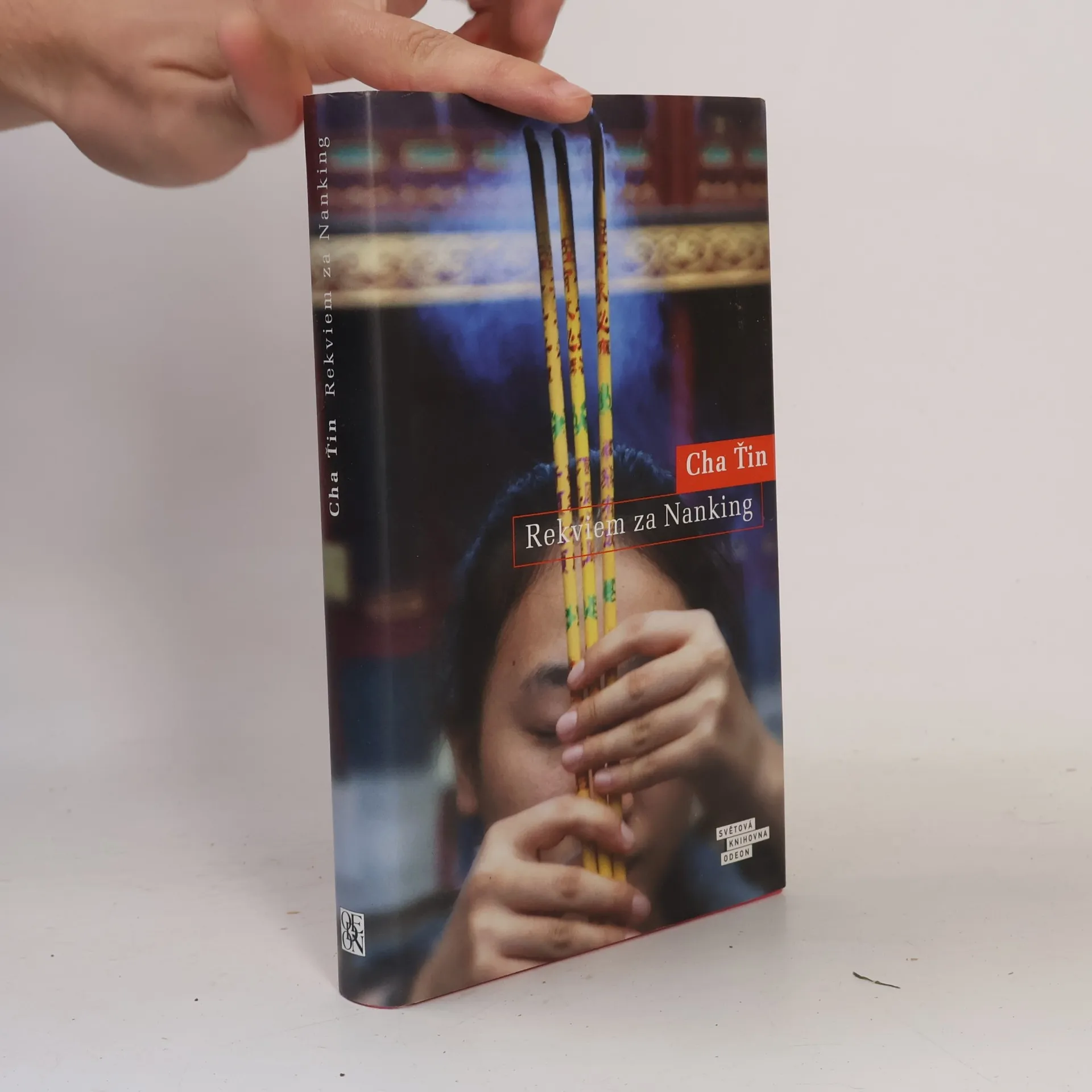
Nankingské rekviem je literárním zpracováním otřesné události známé jako Nankingský masakr, která se udála na přelomu 1937/1938. Během druhé čínsko-japonské války dobyla císařská japonská armáda Nanking, a poté následovalo bezprecedentní hromadné vraždění mužů a znásilňování žen, odhad počtu obětí dosahuje čtyřset tisíc. Autor vychází z dokumentů a pramenů, celý příběh však nechává vyprávět fiktivní postavou v ich-formě.