

The first English-language collection of the work of one of Europe's top legal sociologists, introducing his influential theories of societal constitutionalism and legal autopoiesis. -- .
Gunther Teubner Pořadí knih


- 2019
- 2017
De unos años para acá hace presencia en las discusiones sobre sociología y teoría jurídica la comprensión del derecho basada en el paradigma de sistemas sociales autorreferentes con carácter autopoiético. Durante varios años, el emérito profesor de la Universidad de Frankfurt Gunther Teubner ha participado activamente en esta discusión con originales y enriquecedores aportes. El libro que aquí se presenta es quizá la obra más central y representativa de sus diferentes desarrollos teóricos. Entre otros aspectos, el autor nos presenta una reformulación del sistema jurídico autopoiético como un hiperciclo que se consolida en el tiempo, mediante procesos diferentes de autorreproducción, automantenimiento, y autodescripción.
- 2016
Crime, The Mystery of the Common-Sense Concept
- 272 stránek
- 10 hodin čtení
Crime is a source of endless fascination and fear. Yet behind the apparent consensus that crime must be fought, there is considerable conflict about what should or should not be treated as criminal, and even the most shocking crimes can inspire divisive debate.
- 2014
Constitutional fragments
- 228 stránek
- 8 hodin čtení
The powerful private sectors of the world economy remain unconstrained by fundamental constitutional rules, leading to human rights abuses on a massive scale. This book examines how the values of constitutional governance can be applied to the private sphere in the modern world, through a network of constitutional fragments.
- 2012
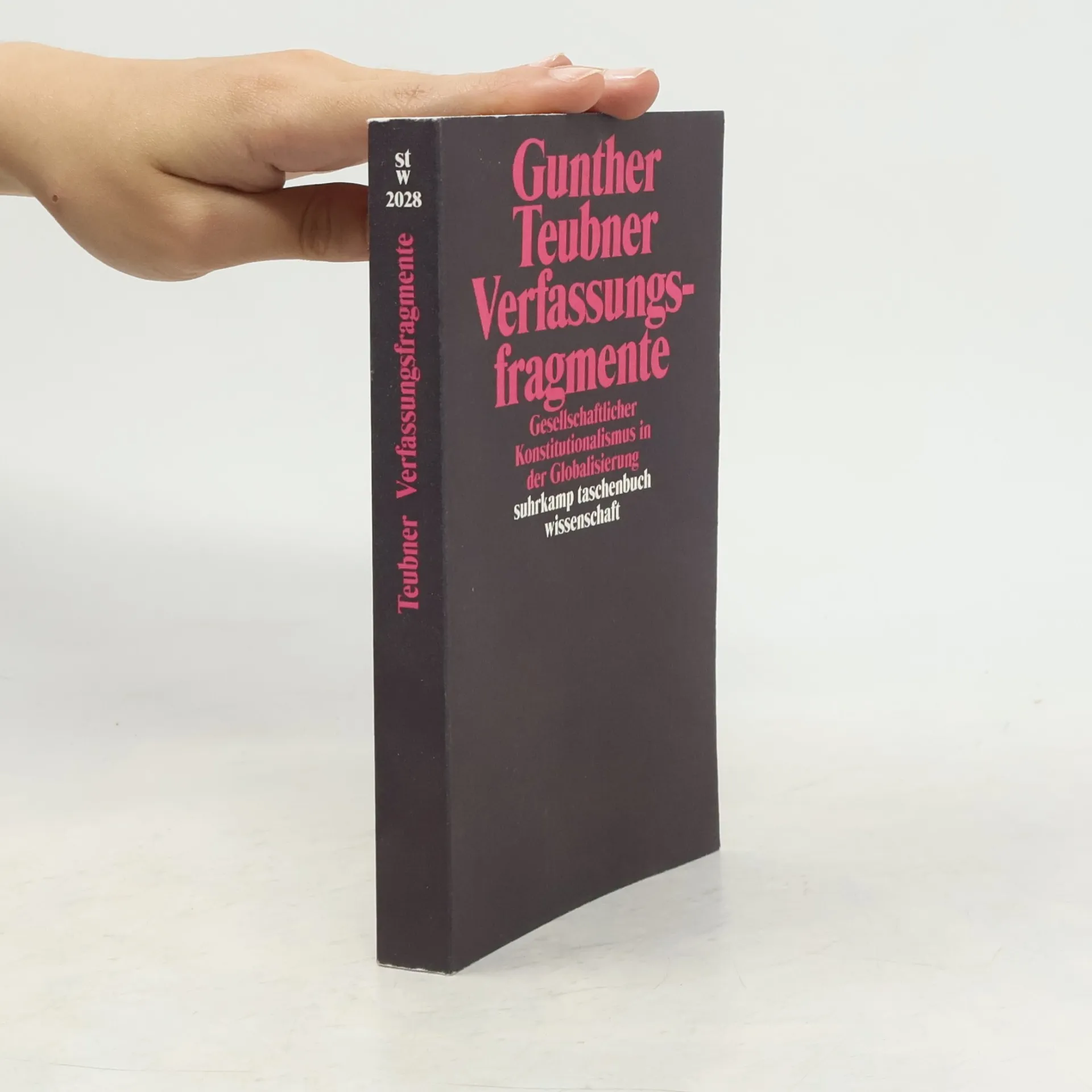
Verfassungsfragmente
Gesellschaftlicher Konstitutionalismus in der Globalisierung
Nicht zuletzt durch eine Reihe von öffentlichen Skandalen wurde in den letzten Jahren die »Neue Verfassungsfrage« aufgeworfen. Menschenrechtsverletzungen durch multinationale Unternehmen, Korruption im Medizin- und Wissenschaftsbetrieb, Bedrohung der Meinungsfreiheit durch private Intermediäre im Internet, massive Eingriffe in die Privatsphäre durch Datensammlung privater Organisationen und mit besonderer Wucht die Entfesselung katastrophaler Risiken auf den weltweiten Kapitalmärkten – sie alle werfen Verfassungsprobleme im strengen Sinne auf. Ging es früher um die Freisetzung der politischen Machtenergien des Nationalstaats und zugleich um ihre wirksame rechtsstaatliche Begrenzung, so geht es nun darum, ganz andere gesellschaftliche Energien zu diskutieren und in ihren destruktiven Konsequenzen wirksam zu beschränken. Konstitutionalismus jenseits des Nationalstaats – das heißt zweierlei: Die Verfassungsprobleme stellen sich außerhalb der Grenzen des Nationalstaats in transnationalen Politikprozessen und zugleich außerhalb des institutionalisierten Politiksektors in den »privaten« Sektoren der Weltgesellschaft.
- 2010
The Politics of the Police
- 334 stránek
- 12 hodin čtení
This book covers the history of the police, the sociology of policing, and the law and politics of the police. From Clint Eastwood's Dirty Harry to Life on Mars, Robert Reiner explores the highly-charged debates that surround policing and analyses the proposals for reform.
- 2008
Over the last two decades, and in the wake of increases in recorded crime and other social changes, British criminal justice policy has become increasingly politicised as an index of governments' competence. New and worrying developments, such as the inexorable rise of the US prison population and the rising force of penal severity, seem unstoppable in the face of popular anxiety about crime. But is this inevitable? Nicola Lacey argues that harsh 'penal populism' is not the inevitable fate of all contemporary democracies. Notwithstanding a degree of convergence, globalisation has left many of the key institutional differences between national systems intact, and these help to explain the striking differences in the capacity for penal tolerance in otherwise relatively similar societies. Only by understanding the institutional preconditions for a tolerant criminal justice system can we think clearly about the possible options for reform within particular systems.
- 2008
Gegenüber der aktuellen sozial- und rechtsphilosophischen Debatte zur Gerechtigkeit, die zwischen den Polen der Universalität und der Alterität oszilliert, arbeiten die Autoren des Bandes eine dritte, eine sozialtheoretische, Argumentationslinie heraus. Ausgangspunkt sind die Paradoxien des Rechts, wie sie von Jacques Derrida und Niklas Luhmann formuliert worden sind. In Luhmanns „Kontingenzformel des Rechts“ erscheint Gerechtigkeit nicht primär als philosophische Frage, sondern als konkrete Praxis der jeweiligen Selbstbeschreibungen des Rechtssystems, welche die bloße Konsistenz des Recht übersteigt und sich an den Anforderungen der Umwelten des Rechts orientiert. Die Autoren des Bandes konfrontieren die Luhmannsche Kontingenzformel mit dem Gerechtigkeitskonzept von Derrida, die auf eine Transzendenz des Rechts in ganz anderer Richtung zielt. Diese ist für die Rechtsoperationen prinzipiell nicht erreichbar, ihren Anforderungen aber sind sie ständig und ohne Ausweichmöglichkeit ausgesetzt. Was ergibt sich aus dieser Konfrontation für die Neuformulierung von Grundbegriffen des Rechts: Gerechtigkeit, Rechtssubjektivität, subjektives Recht, Rechtsgenese, Rechtsargumentation?