
Tento teoretický fyzik proslul svými přínosy k teorii kvarků a vývoji kvantové chromodynamiky. Jeho práce v oblasti velkého sjednocení standardního modelu částicové fyziky představuje zásadní krok k pochopení základních sil vesmíru. Hluboce se zabýval komplexními modely leptonů a kvarků a zkoumal jejich hmotnostní matice.
Murray Gell-Mann, a Nobel Prize-winning physicist, is renowned for his groundbreaking contributions to elementary particle physics, particularly the introduction of quarks. His collaborative work with H. Fritzsch on Quantum Chromodynamics has significantly advanced the understanding of fundamental forces and particles. This book delves into Gell-Mann's theories, exploring their impact on modern physics and how they reshaped our comprehension of the universe's building blocks.
Focusing on the foundations of particle physics, this book delves into the Standard Model, which explains the behavior of electrons and quarks through quantum field theories. It begins with classical and relativistic mechanics before exploring classical scalar fields, electrodynamics, and quantum mechanics. The text further elaborates on the quantization processes for scalar, spinor, and vector fields, providing a comprehensive understanding of the underlying principles that govern the dynamics of matter in the universe.
The groundbreaking discovery of gravitational waves in February 2016, resulting from the collision of two black holes 1.3 billion years ago, marked a significant milestone in physics, affirming Einstein's century-old predictions. Detected by the Laser Interferometer Gravitational-Wave Observatory (LIGO), this event raises critical questions about integrating gravitational interactions into the Standard Theory of particle physics, which currently explains electroweak and strong interactions in the universe.
The book delves into the limitations of the Standard Theory of Particle Physics, exploring unresolved questions such as the integration of gravity, the nature of particle masses, and the characteristics of neutrinos. It examines the implications of the newly discovered boson at CERN and considers the possibility of new symmetries, including broken supersymmetry. Additionally, it raises fundamental inquiries about the structure of leptons and quarks, questioning whether they are point-like or composite, and if they might be one-dimensional objects like superstrings at extremely small distances.
Today it is known that the atomic nuclei are composed of smaller constituents, the quarks. A quark is always bound with two other quarks, forming a baryon or with an antiquark, forming a meson. The quark model was first postulated in 1964 by Murray Gell-Mann — who coined the name “quark” from James Joyce's novel Finnegans Wake — and by George Zweig, who then worked at CERN. In the present theory of strong interactions — Quantum Chromodynamics proposed by H Fritzsch and Gell-Mann in 1972 — the forces that bind the quarks together are due to the exchange of eight gluons.On the 50th anniversary of the quark model, this invaluable volume looks back at the developments and achievements in the elementary particle physics that eventuated from that beautiful model. Written by an international team of distinguished physicists, each of whom have made major developments in the field, the volume provides an essential overview of the present state to the academics and researchers.

Neutrino physics is explored through the implications of neutrino oscillations, highlighting their small mass and mixing with charged leptons. The book compiles insights from prominent researchers, addressing critical questions such as the nature of neutrino masses—whether Dirac or Majorana—and the significance of oscillation experiments. Topics include CP-violation in leptons, texture zero mass matrices, and the role of neutrinos in astrophysics and cosmology, reflecting discussions from a recent conference on the state of this intriguing field.
Die Geheimnisse des Mikrokosmos aufzudecken, hat die Physiker seit Jahrhunderten fasziniert. Doch obwohl in den vergangenen Jahrzehnten viele interessante Entdeckungen gemacht wurden, bleiben noch Fragen offen, die Harald Fritzsch in diesem Buch von der physikalischen und mathematischen Seite beleuchtet: - Haben die Physiker mit der Standardtheorie der Elementarteilchenphysik schon eine exakte Beschreibung der Teilchenwelt gefunden? - Gibt es wirklich eine „Große Vereinigung“ aller fundamentalen Kräfte? - Und sind die Leptonen, (wie das Elektron), oder die Bausteine der Hadronen , (die Quarks), vielleicht gar nicht wirklich punktförmig, sondern kleine eindimensionale Objekte, die man als „Strings“ bezeichnet? Dieses Buch setzt mathematische Vorbildung voraus und versteht sich als Überblick über die modernen Grundlagen der Quantenfeldtheorie und als Diskussionsbeitrag. Somit eignet sich das Werk insbesondere auch als Überblick und Wiederholungfür Physiker. Harald Fritzsch ist bereits als Autor populärwissenschaftlicher Bücher bekannt. Sein Buch „Quarks“, das in München 1980 erschien, wurde in mehr als 20 Sprachen übersetzt. Der Autor Prof. Harald Fritzsch (* 10. Februar 1943 in Zwickau) ist ein theoretischer Physiker, der vor allem wichtige Beiträge zur Theorie der Quarks, zur Entwicklung der Quantenchromodynamik und zur Großen Vereinheitlichung des Standardmodells der Elementarteilchen geleistet hat.
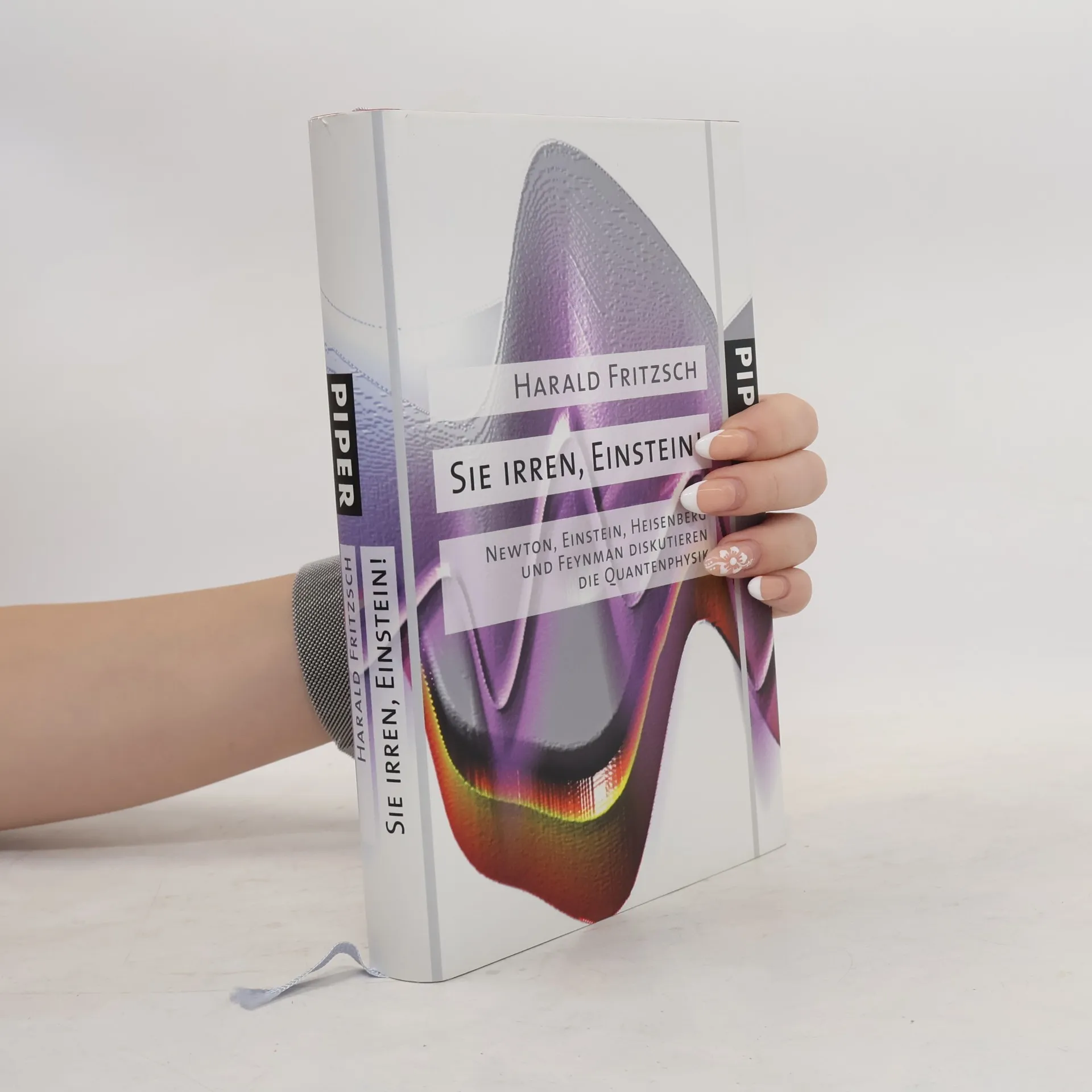
This book provides the readers with a broad introduction to the field of particle physics through fictional discussions between three prominent physicists -- Albert Einstein, Issac Newton, and Murray Gell-Mann -- together with a modern physicist.Matter is composed of quarks and electrons. The forces between quarks are generated by exchanges of gluons and are so strong that they result in the confinement of quarks in atomic nuclei, whereas the forces between electrons and atomic nuclei are generated by exchanges of photons, and the forces between quarks and electrons (or any other leptons) are generated by exchanges of weak bosons.The book is suitable for non-experts in physics.
Um zu verstehen, warum alles, was uns umgibt, existiert – Menschen, Tiere, Pflanzen, Planeten, das Universum – müssen wir unser Auge vom Riesiggroßen auf das Winzigkleine lenken. Vom Universum auf das Atom. Vom Makrokosmos auf den Mikrokosmos. Dort suchen die Physiker nach der Formel, die den Aufbau der Welt erklären kann. Im Mikrokosmos gibt es unvorstellbar kleine Teilchen, so klein, dass man sie niemals sehen wird, sondern ihre Existenz nur berechnen kann. Hier befinden wir uns im Reich der sonderbaren Quarks, hier tüftelt die moderne Physik am sogenannten Standardmodell, an der Weltformel, die mit den kleinsten Teilchen das Größte erklären kann, nämlich 'alles'. Was die moderne Teilchenphysik ist und wo die letzten Fragen offen bleiben – das alles erklärt der Ausnahmephysiker und Bestsellerautor Harald Fritzsch in leichter Sprache und mit feinem Witz. Er lässt Albert Einstein, Isaac Newton, Murray Gell-Mann und sein Alter Ego zu einem fiktiven Gespräch zusammenkommen: Bei Filet Mignon und teurem Rotwein entspinnt sich eine erhellende Diskussion über den Mikrokosmos und am Ende versteht nicht nur Sir Isaac Newton die neuesten Erkenntnisse der modernen Physik, sondern auch der Leser