
Quantitative Sociodynamics outlines a strategy for interdisciplinary model building, focusing on a quantitative analysis of behavioral changes through social interactions. The foundational methods for modeling complex systems—stochastic methods and nonlinear dynamics—originated in physics but have proven effective in fields like chemistry, biology, economics, and social sciences. This work offers a unified overview of various stochastic methods, their interrelations, and properties, while also introducing key nonlinear dynamics concepts such as synergetics and chaos theory. The text discusses how these concepts can be applied to social phenomena and presents a fundamental dynamic model that incorporates decision-theoretical approaches, potentially transforming perspectives within social sciences. It encompasses established models like the logistic equation, gravity model, diffusion models, evolutionary game theory, and social field theory, while also revealing new findings. The book includes examples of opinion formation, migration, social field theory, and the self-organization of behavioral conventions, supported by computer simulations. It serves as a valuable resource for both social and natural scientists interested in applying stochastic and synergetics concepts to interdisciplinary issues.
Dirk Helbing Knihy


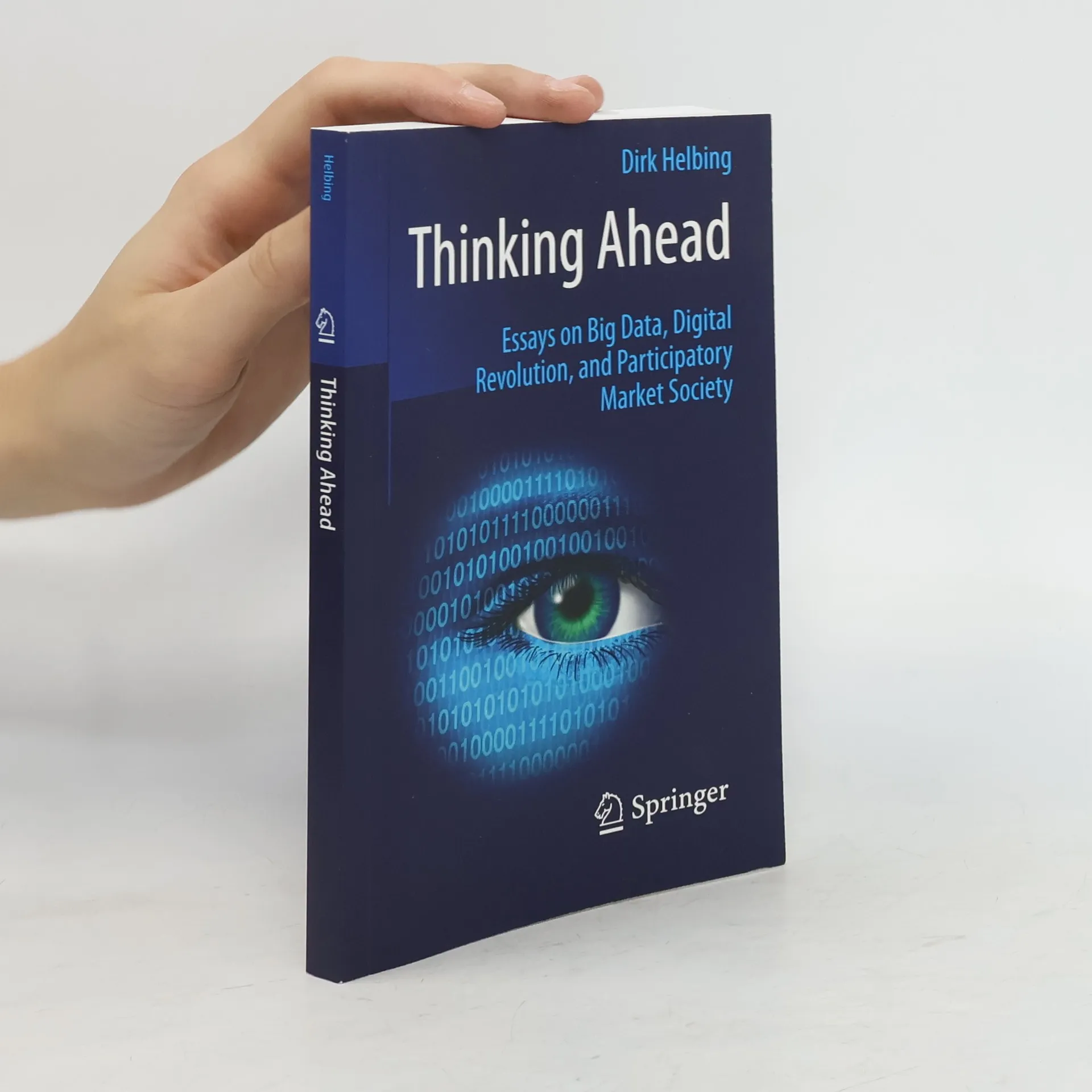
Thinking Ahead - Essays on Big Data, Digital Revolution, and Participatory Market Society
- 208 stránek
- 8 hodin čtení
"The rapidly progressing digital revolution is now touching the foundations of the governance of societal structures. Humans are on the verge of evolving from consumers to prosumers, and old, entrenched theories - in particular sociological and economic ones - are falling prey to these rapid developments. The original assumptions on which they are based are being questioned. Each year we produce as much data as in the entire human history - can we possibly create a global crystal ball to predict our future and to optimally govern our world? Do we need wide-scale surveillance to understand nd manage the increasingly complex systems we are constructing, or would bottom-up approaches such as self-regulating systems be a better solution to creating a more innovative, more successful, more resilient, and ultimately happier society? Working at the interface of complexity theory, quantitative sociology and Big Data-driven risk and knowledge management, the author advocates the establishment of new participatory systems in our digital society to enhance coordination, reduce conflict and, above all, reduce the "tragedies of the commons," resulting from the methods now used in political, economic and management decision-making."--Back cover
Next Civilization
Digital Democracy and Socio-Ecological Finance - How to Avoid Dystopia and Upgrade Society by Digital Means
- 349 stránek
- 13 hodin čtení
"Digital transformation" sounds harmless, given that the explosion in data volumes, processing power and Artificial Intelligence has driven humanity and the entire world to a point of no return. We will surely see a new civilization, but we are at a crossroads. The future needs to be re-invented, decisions must be taken. After the automation of factories and the creation of self-driving cars, the automation of society is on its way. But there are two kinds of automation: a centralized top-down control of the world and a distributed control approach, supporting local self-organization. Using the power of today’s information systems, governments and big tech companies seem to engage in the first approach. Might they even build a „digital Crystal Ball“ that knows almost everything, including your personality, and a super-intelligent "digital God“ to control what we do? We are much closer to such „science fiction scenarios“ than you probably think. In this much expanded second edition of "The Automation of Society is Next: How to Survive the Digital Revolution" (2015), the author discusses lessons learned on digital democracy, aspects of transhumanism and far-reaching thoughts about life in the digital age and what it may mean to be human in the future.
The Automation of Society Is Next
- 266 stránek
- 10 hodin čtení
The explosion in data volumes, processing power, and Artificial Intelligence, known as the "digital revolution", has driven our world to a dangerous point. One thing is increasingly clear: We are at a crossroads. We need to make decisions. We must re-invent our future. [This full colour book includes 32 figures and visualisations.] After the automation of factories and the creation of self-driving cars, the automation of society is next. But there are two kinds of automation: a centralized top-down control of the world, and a distributed control approach supporting local self-organization. Using the power of today's information systems, governments and companies like Google seem to engage in the first approach. Will they even try to build a "digital God" who knows everything and controls what we do? In fact, governments would spend billions to predict the future of our world and control its path. Given that, every year, we produce as much data as in the entire history of humankind, can we now create a better world? The abundance of data certainly makes it possible to establish an entirely new paradigm for running our societies. Could we even build a data-driven "crystal ball" to predict the future and, given that knowledge implies power, also something like a "magic wand" to optimally rule the world? Will the digital revolution empower a "wise king" or "benevolent dictator", maybe by means of Artificial Intelligence? In fact, we are much closer to this than you might think. But do we really need large-scale surveillance to understand and manage the increasingly complex systems we have created? Or are we running into a totalitarian nightmare?
Das Buch behandelt die neuesten Fortschritte in der Modellierung und Simulation von Fußgänger- und Autobahnverkehr, wobei physikalische und sozialwissenschaftliche Ansätze kombiniert werden. Ein zentrales Thema ist der Vergleich dieser Modelle mit empirischen Daten. Zudem wird das Phänomen der "Staus aus dem Nichts" sowie andere interessante kollektive Bewegungsmuster untersucht, die durch Selbstorganisation entstehen.