

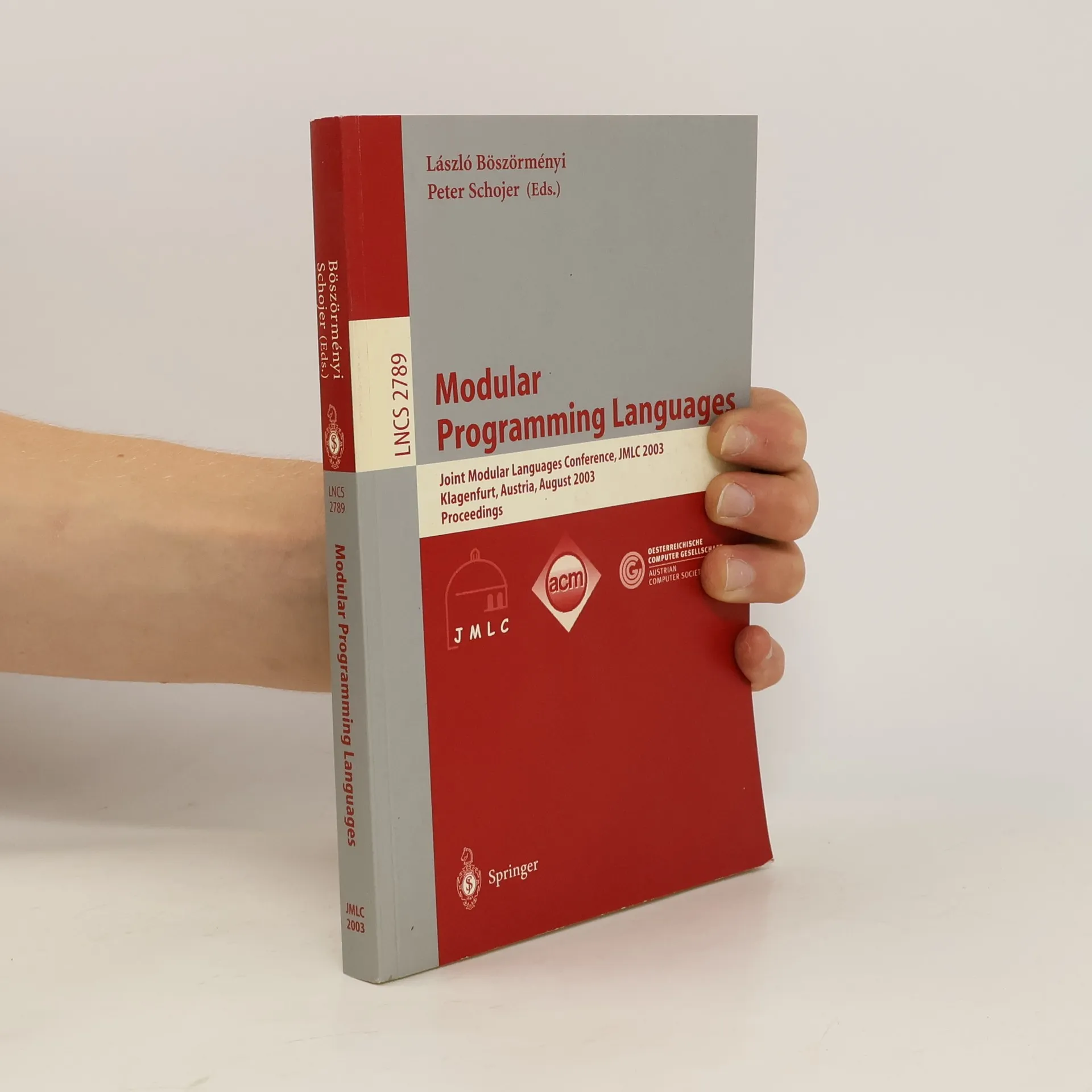


Modular programming languages
Autoři
Více o knize
The book features a collection of invited talks that delve into various aspects of programming languages and software development. Topics include the evolution of safe code beyond applets, the challenges of computing with distributed resources, and the vision of a verifying compiler as a grand challenge in computing research. It discusses lessons learned from evolving a multi-language object-oriented framework like .NET, and explores architectural concepts in education. Contributions address compiler support for reference tracking in type-safe distributed shared memory, the concept of caste as an advancement in object orientation, and the use of distributed XML objects. Programming education is examined from a Russian perspective, while component architectures and adaptive distributed multimedia streaming server architectures based on service-oriented components are also highlighted. The text covers layered type systems for re-entrance control, practical approaches to software portability, and object life-cycle management in flexible middleware systems. It discusses real-time systems development using hierarchical state machines, minimal module models like classboxes, and language experiments such as Zonnon for .NET. Other topics include frameworks and design principles, event-driven design libraries, and architectural aspects of thread-safe graphical component systems. The book also addresses compiler and tool development,
Nákup knihy
Modular programming languages, Laszlo Böszörmenyi
- Jazyk

- Rok vydání
- 2003
- Vazba
- (měkká)
Doručení
Platební metody
Nikdo zatím neohodnotil.
- Titul
- Modular programming languages
- Jazyk
- anglicky
- Autoři
- Laszlo Böszörmenyi
- Vydavatel
- Springer
- Rok vydání
- 2003
- Vazba
- měkká
- Počet stran
- 271
- ISBN10
- 3540407960
- ISBN13
- 9783540407966
- Série
- Štítky
- Anotace
- The book features a collection of invited talks that delve into various aspects of programming languages and software development. Topics include the evolution of safe code beyond applets, the challenges of computing with distributed resources, and the vision of a verifying compiler as a grand challenge in computing research. It discusses lessons learned from evolving a multi-language object-oriented framework like .NET, and explores architectural concepts in education. Contributions address compiler support for reference tracking in type-safe distributed shared memory, the concept of caste as an advancement in object orientation, and the use of distributed XML objects. Programming education is examined from a Russian perspective, while component architectures and adaptive distributed multimedia streaming server architectures based on service-oriented components are also highlighted. The text covers layered type systems for re-entrance control, practical approaches to software portability, and object life-cycle management in flexible middleware systems. It discusses real-time systems development using hierarchical state machines, minimal module models like classboxes, and language experiments such as Zonnon for .NET. Other topics include frameworks and design principles, event-driven design libraries, and architectural aspects of thread-safe graphical component systems. The book also addresses compiler and tool development,